Laser Hair Removal & Skin Tones Liverpool: The Facts
Many people across Liverpool ask the same question before booking their first appointment: does laser hair removal actually work for my skin tone? It is a completely fair question, and the honest answer is more nuanced than a simple yes or no. Laser hair removal skin tones Liverpool is one of the most searched phrases we see, and it reflects a real gap between what people assume (that laser only works on pale skin) and what modern technology actually delivers. If you have been told elsewhere that your skin is too dark, or your hair is too light, this article lays out the clinical facts so you can make a properly informed decision.
Table of Contents
- Quick Takeaways
- The Fitzpatrick Scale: How Clinics Actually Classify Your Skin
- How Laser Targets Hair, Not Skin
- Which Laser Works Best for Which Skin Tone
- Laser Hair Removal on Dark Skin: What You Need to Know
- Lighter Skin Tones and the Hair Colour Problem
- Why a Patch Test and Consultation Are Non-Negotiable
- Frequently Asked Questions
- References
Quick Takeaways
| Key Insight | Explanation |
|---|---|
| Modern technology covers all six Fitzpatrick skin types | Advances in laser wavelengths mean virtually every skin tone can now be treated safely, provided the right laser is selected. |
| The Nd:YAG laser is the go-to for dark skin | Its 1064 nm wavelength bypasses surface melanin and targets the hair follicle directly, making it the clinically recommended option for Fitzpatrick Types IV to VI. |
| Hair colour matters as much as skin tone | Laser targets melanin in the hair follicle. Blonde, grey, and white hair contain too little melanin to respond effectively, regardless of skin tone. |
| Fitzpatrick Type I and II get the best results with alexandrite | The 755 nm alexandrite wavelength is highly absorbed by melanin and works with precision on lighter skin tones with dark hair. |
| Using the wrong laser on dark skin causes burns | Shorter wavelengths absorbed by surface melanin can damage the epidermis if used on darker skin. This is why laser choice and settings are critical. |
| A proper consultation determines your correct Fitzpatrick type | A trained clinician assesses your skin type, hair colour, and medical history before any treatment begins. This is not optional. |
| Sun exposure changes your Fitzpatrick type temporarily | A tan raises your effective skin type and increases risk. Clinics will delay treatment on recently tanned skin for this reason. |
The Fitzpatrick Scale: How Clinics Actually Classify Your Skin
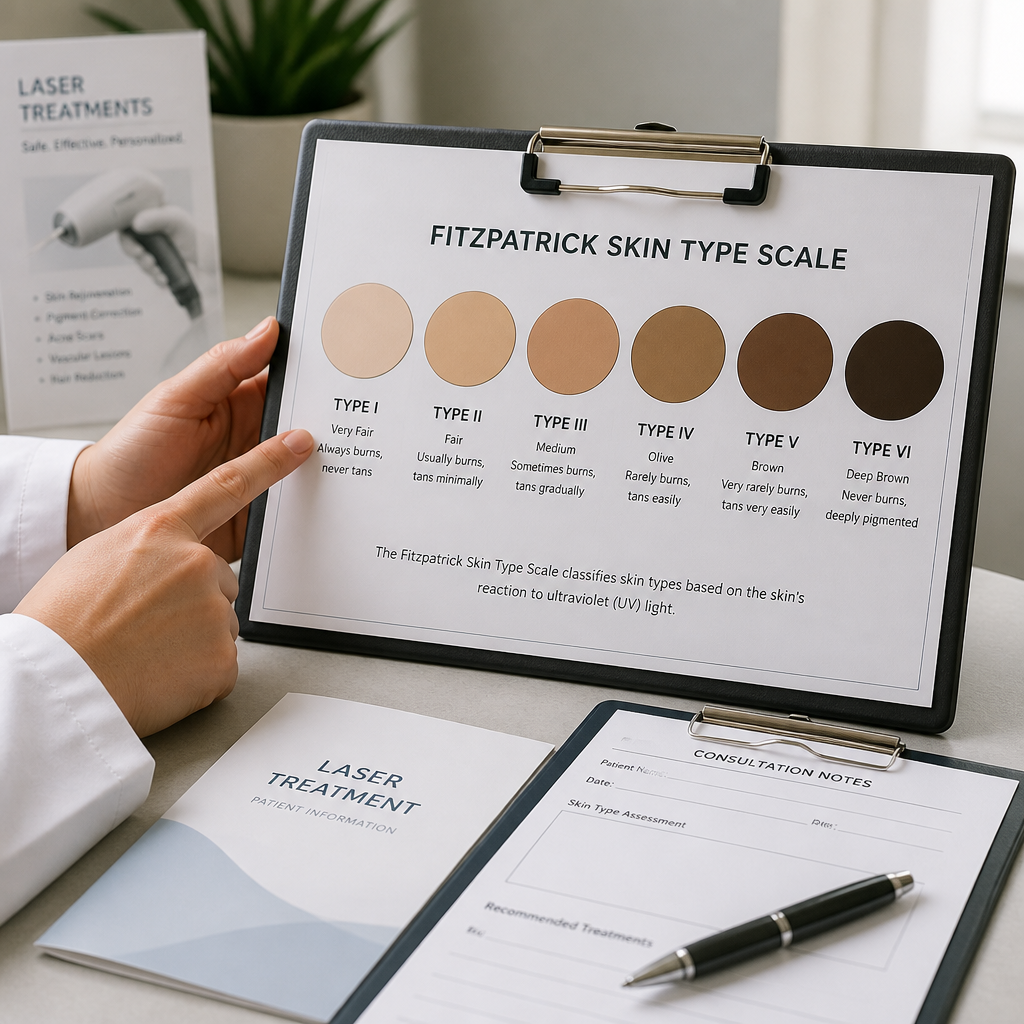
Before any laser is pointed anywhere near your skin, a competent clinic will classify your skin using the Fitzpatrick Skin Type Scale. This system was developed in 1975 and categorises skin into six types based on how much melanin it contains and how it responds to UV light, specifically whether it burns, tans, or both.
Here is a plain-English breakdown of the six types:
- Type I: Pale, often freckled skin. Always burns, never tans. Often paired with red or blonde hair and blue or green eyes.
- Type II: Fair skin. Burns easily, tans minimally. Common in people with blonde hair and blue eyes.
- Type III: Medium-light skin. Burns first, then gradually tans. The most common type across the UK population.
- Type IV: Olive or light brown skin. Rarely burns, tans easily. Common in Mediterranean and some South Asian backgrounds.
- Type V: Brown skin. Very rarely burns. Common in South Asian, Middle Eastern, and Latino backgrounds.
- Type VI: Deep brown or black skin. Never burns. Common in people of African and Afro-Caribbean descent.
Why does this matter? Because the Fitzpatrick type directly determines which laser wavelength is safe and effective for you. This is not a cosmetic preference, it is a clinical decision.
The Fitzpatrick scale is not just a classification tool. It is the foundation on which safe laser treatment is built. Get the classification wrong and you risk burning skin. Get it right and virtually every skin tone can be treated effectively.
Pro tip: Do not try to self-classify your Fitzpatrick type based on a chart online. Factors like recent sun exposure, natural skin reaction patterns, and hair colour all feed into the assessment. Let a trained clinician at Faith Laser do this properly at your consultation.
How Laser Targets Hair, Not Skin
The core principle behind laser hair removal is called selective photothermolysis. In plain terms, the laser emits a specific wavelength of light that is absorbed by melanin, the pigment found in your hair follicles. That absorbed energy converts to heat, which damages the follicle and inhibits future hair growth.
The challenge is that melanin is also found in your skin, not just your hair. On lighter skin tones, there is a clear contrast between the pigment in the hair follicle and the surrounding skin, which makes it easier for the laser to lock onto the right target without affecting the skin itself. On darker skin tones, the melanin in the skin competes with the melanin in the hair follicle, which is where things get clinically complicated, and where the wrong laser causes burns.
The solution is wavelength. Longer laser wavelengths penetrate deeper into the dermis and are less readily absorbed by surface melanin. This is the engineering principle that makes modern laser treatment safe for darker skin tones. It is not a workaround, it is how the physics is supposed to work when the right tool is used.
One limitation that no laser can overcome: if there is no melanin in the hair, there is no target. This is why blonde, grey, red, and white hair responds poorly or not at all to laser treatment regardless of the person’s skin tone. The laser needs a pigment target to work.
Which Laser Works Best for Which Skin Tone
Not all laser systems are created equal, and a clinic that only operates one type of laser cannot safely treat the full range of skin tones. Here is how the main technologies compare across Fitzpatrick types:
| Laser Type | Wavelength | Best Fitzpatrick Types |
|---|---|---|
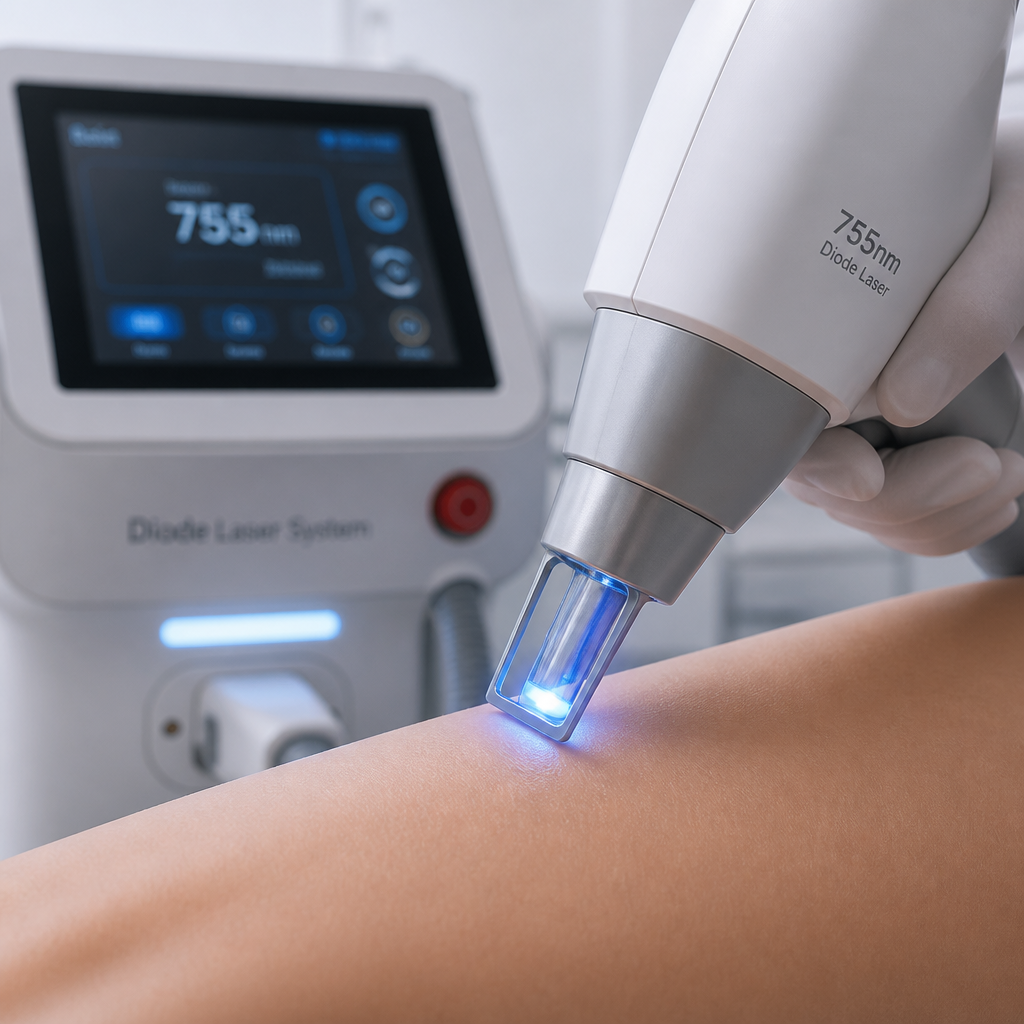
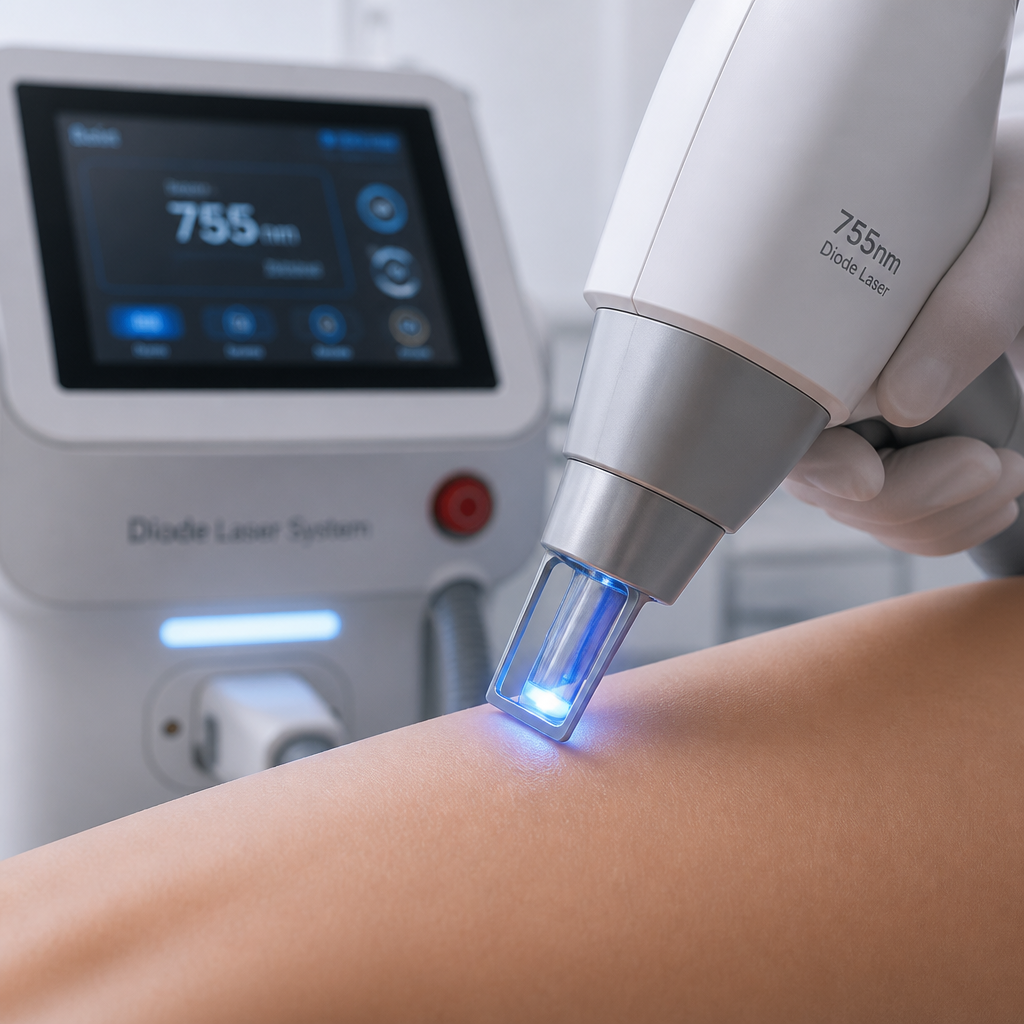
| Alexandrite | 755 nm | Types I, II, III (lighter skin with dark hair). Highly effective but poses risk on darker skin tones due to strong melanin absorption at the surface. |
| Diode | 630 to 900 nm range | Types II through IV. A broader range than alexandrite alone, but can still carry risk on Types V and VI if settings are not precisely calibrated for deeper pigmentation. |
| Nd:YAG | 1064 nm | Types IV, V, VI (and suitable across all types). The longer wavelength reaches the hair follicle more effectively in people with higher levels of skin pigmentation, with significantly reduced risk of surface damage. |
The clinical consensus is clear. The alexandrite laser is the stronger option for Fitzpatrick Types I through III. The Nd:YAG is the clinically appropriate choice for Fitzpatrick Types IV through VI. Many well-equipped clinics use both wavelengths to cover their full client base properly.
Pro tip: When you enquire about laser hair removal at any clinic, ask specifically which laser system they use and whether it is appropriate for your Fitzpatrick skin type. If a clinic cannot answer that question clearly, walk away.
Laser Hair Removal on Dark Skin: What You Need to Know
For a long time, the industry’s default position was that laser hair removal worked best on pale skin with dark hair. That was an accurate description of the technology available at the time, not a permanent limitation. Laser hair removal for dark skin in Liverpool is now a realistic option with the right equipment and trained hands.
The Nd:YAG Advantage
At 1064 nm, the Nd:YAG laser operates at a wavelength that is less readily absorbed by melanin in the upper layers of the skin. This means it can reach the hair follicle effectively in clients with Fitzpatrick Types IV, V, and VI without the surface absorption that causes burns when shorter-wavelength lasers are used on darker skin. This is not a compromise option, it is the clinically recommended approach.
What Darker Skin Tones Should Watch For
Even with the correct laser, there are factors that increase risk on darker skin tones, and a good clinic will discuss all of them upfront:
- Recent sun exposure or tanning: A tan raises your effective Fitzpatrick type temporarily. Treatment on recently tanned skin increases the risk of hyperpigmentation, where the skin produces too much melanin in response to the laser’s heat. Avoid sun exposure and self-tan products for at least two weeks before treatment.
- Post-inflammatory hyperpigmentation (PIH): Darker skin tones are more prone to PIH, which appears as darker patches at the treatment site. This risk drops significantly with the correct laser, correct settings, and good aftercare.
- Treatment intervals: Darker skin may benefit from slightly longer intervals between sessions to allow the skin to recover fully. Your clinician should build this into your treatment plan, not apply a one-size-fits-all schedule.
The Role of Settings, Not Just the Laser
Even the correct laser can cause damage if the energy settings are wrong. Fluence (energy density), pulse duration, and spot size all need to be adjusted based on your specific skin type, hair thickness, and treatment area. This is where clinical training and experience directly protect you. A practitioner who dials in the same settings for every client, regardless of skin tone, is taking shortcuts that can harm darker skin.
Lighter Skin Tones and the Hair Colour Problem
People with Fitzpatrick Types I and II tend to assume laser hair removal is the easiest choice for them, and in terms of skin safety, they are largely right. The contrast between light skin and dark hair is ideal for laser targeting. However, lighter skin tones are most likely to also have lighter hair, and hair colour is the other half of the equation.
Laser hair removal depends entirely on melanin being present in the hair follicle. Blonde, grey, red, and white hair contains significantly less melanin than dark brown or black hair. As a result, the laser has very little to absorb in those follicles, which means the treatment will deliver poor results or none at all. This is not a matter of adjusting settings or using a more powerful machine. The physics simply does not work without the pigment target.
In practice, this means a person with Fitzpatrick Type I and naturally blonde or grey hair is not a suitable candidate for laser hair removal, regardless of how pale and ideal their skin might otherwise appear. Red hair is a similar story. The hair may have enough melanin in some cases for partial results, but expectations need to be managed honestly from the outset.
The ideal candidate across all skin tones is someone with hair that is noticeably darker than their skin. The greater that contrast, the more precisely the laser can target the follicle without interference from the surrounding skin.
Why a Patch Test and Consultation Are Non-Negotiable
A reputable laser clinic does not start treatment on the first visit. A consultation and patch test are essential steps that exist for your safety, not as a bureaucratic box-ticking exercise.
What Happens at Your Consultation
Your clinician will assess your Fitzpatrick skin type, examine your hair colour and thickness, review your medical history, and discuss any medications you are taking. Some medications increase photosensitivity and can make laser treatment unsafe. Conditions like active skin infections, certain autoimmune conditions, and pregnancy are contraindications that a proper consultation will catch.
The Patch Test
A patch test involves treating a small area of skin at the planned settings before the full treatment begins. This lets the clinician observe how your skin reacts: whether the hair follicle responds as expected, and whether the surrounding skin shows any adverse reaction. For darker skin tones in particular, a patch test is not optional. It is the only way to validate that the chosen settings are safe for your specific skin before treating a larger area.
At Faith Laser in Liverpool, every new client goes through a proper consultation before any laser device is used. This is not the approach of every clinic in the city, and it is one of the clearest markers of a clinic that genuinely prioritises your outcomes over throughput.
Pro tip: If a clinic offers to skip the consultation and start treatment immediately because “you seem like a standard case,” that is a red flag. Skin type assessment is not something that can be done by eye in thirty seconds.
Frequently Asked Questions
Can dark skin have laser hair removal safely?
Yes. With the correct laser, specifically the Nd:YAG at 1064 nm, laser hair removal is safe and effective for darker skin tones including Fitzpatrick Types IV, V, and VI. The key is using a laser whose wavelength bypasses surface melanin and targets the hair follicle directly. The risk comes from using the wrong laser or incorrect settings, not from dark skin itself.
Who cannot have laser hair removal regardless of skin tone?
Anyone with blonde, grey, white, or very light red hair is unlikely to see effective results, because laser targets the melanin in the hair follicle and these hair colours contain too little of it. Additionally, people who are pregnant, breastfeeding, or taking certain photosensitising medications are not suitable candidates until those contraindications are resolved.
How many sessions will I need if I have a darker skin tone?
The number of sessions depends on the treatment area, hair thickness, and hair growth cycle rather than skin tone alone. Most clients across all skin types require between six and eight sessions for significant, lasting hair reduction. Darker skin tones may benefit from slightly longer gaps between sessions to allow for full skin recovery, which your clinician should factor into your plan.
Is laser hair removal on dark skin more painful?
The Nd:YAG laser used on darker skin tones typically uses longer pulse durations, which actually distributes heat more gradually and can feel more comfortable than shorter, more intense pulses. Pain perception varies between individuals and treatment areas. Most people describe the sensation as similar to a mild elastic band snap. Cooling systems built into modern handpieces also help manage discomfort during treatment.
What should I avoid before laser hair removal on dark skin?
Avoid sun exposure, sunbeds, and fake tan products for at least two weeks before any session. Tanning raises your effective Fitzpatrick type and significantly increases the risk of burns and hyperpigmentation during treatment. You should also shave the area 24 to 48 hours before your appointment but avoid waxing, threading, or plucking, as these remove the hair root that the laser needs to target.
Does Faith Laser in Liverpool treat all skin tones?
Faith Laser uses professional-grade laser technology and carries out a thorough consultation and patch test with every new client to determine the safest and most effective treatment approach for their specific skin type. Clients across a wide range of skin tones are welcomed, and treatment plans are tailored individually rather than applied as a blanket protocol.
If you have tried to find clear, honest information about whether laser hair removal works for your skin tone and kept hitting vague answers, we would love to hear your experience in the comments below. What questions do you still have, and what has your clinic actually told you?
References
- Overview of how the Fitzpatrick scale shapes laser treatment choices across skin types
- Clinical explainer on laser hair removal safety and technology for dark skin tones
- Peer-reviewed research comparing diode and alexandrite lasers for hair removal on darker skin
- Clinical comparison of alexandrite and Nd:YAG laser wavelengths across Fitzpatrick skin types
- Practical guide to diode, alexandrite, and Nd:YAG laser differences for different skin tones