Tattoo Removal Skin Type: What Your Fitzpatrick Score Means
Two clients can book the same tattoo, with the same size and ink, and still get very different results. The difference is often the skin underneath, which is why your tattoo removal skin type matters more than most people expect. The Fitzpatrick scale gives clinicians a structured way to read that skin, and it shapes which wavelengths we use, how much energy we deliver, and how many sessions your plan will realistically need. This guide explains what the scale measures, how it changes decisions for clients in Liverpool, and what you can do before your first appointment to protect your results.
Table of Contents
- Quick Takeaways
- What the Fitzpatrick Scale Measures
- How Fitzpatrick Types Change Treatment
- Matching Wavelength to Ink and Skin
- Pigment Changes on Deeper Skin
- Comparing Treatment Approaches
- Preparing Your Skin Before Your First Session
- Frequently Asked Questions
- References
Quick Takeaways
| Key Insight | Explanation |
|---|---|
| Fitzpatrick type measures sun reactivity, not colour | Your score reflects whether your skin burns or tans, and that reaction predicts how it responds to laser heat. |
| Melanin changes how much energy reaches the ink | Melanin in the top layer absorbs light, so the same setting can heat deeper skin more than intended. |
| Ink colour and skin type are planned together | A wavelength that clears black ink may do little to red or green pigment, so the plan must match both. |
| A test patch is worth the extra visit | A small treated area shows how your skin heals before the full tattoo is treated. |
| Recent tanning is the most avoidable setback | Sunbed use, holiday tans and self-tanners can change how the skin reacts and raise the risk of pigment change. |
| Deeper skin usually means a longer plan | Conservative energy and wider spacing between sessions reduce risk, but they mean more visits overall. |
What the Fitzpatrick Scale Measures
The Fitzpatrick scale ranks skin from Type I, which is very fair and always burns, to Type VI, which is very dark and rarely burns. It was built to predict how skin reacts to ultraviolet light, and clinicians still rely on it because the same reactivity shapes how skin responds to laser heat.
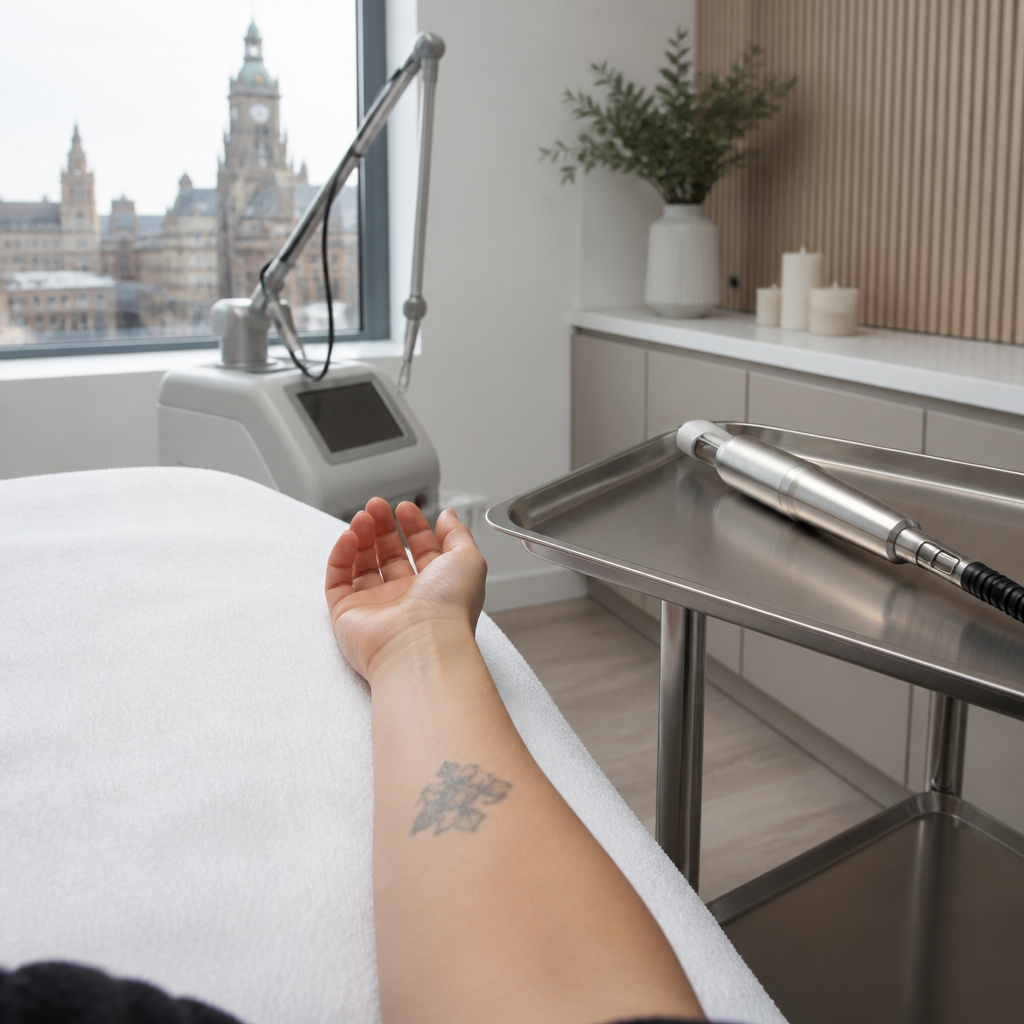
The most common misunderstanding is that the scale grades skin colour. It does not. Two people with similar complexions can sit in different types depending on whether their skin tends to burn or tan after sun exposure, and the score is built around that reaction.
The link to laser work is melanin, the pigment in the top layer of skin. Melanin absorbs light, and the laser beam has to pass through that layer before it reaches the ink. The more melanin present, the more energy the surface absorbs along the way, which is why the same setting can heat the skin more than intended.
Your Fitzpatrick type is not a judgement about your skin. It is a working guide to how much energy the surface can tolerate before the treatment plan is set.
In practice, we treat the score as a starting point rather than a verdict. We ask about your sun history, how your skin has reacted to previous procedures, and whether you tend to burn or tan on holiday, then confirm the picture with a test area.
That combination matters because two people with the same score can still react differently on the day. Certain photosensitising medications, hormonal changes, recent sun exposure and older scarring can all shift the picture, so we check those factors at every consultation.
How Fitzpatrick Types Change Treatment
The scale is most useful when you look at the groups it creates. Each band changes how we set energy, pulse duration and the spacing between sessions.
Types I and II: fair skin that burns easily
Fair skin carries less melanin, so less energy is absorbed at the surface and more reaches the ink. That often allows treatment with settings that clear pigment efficiently, and many clients see visible fading across fewer sessions than people at the deeper end of the scale. The trade-off is that fair skin still needs care, because excess energy at the surface can cause blistering.
Types III and IV: the middle of the scale
This is where most of the judgement happens. Two clients in Type III or IV can respond very differently because their melanin levels, ink depth and sun habits vary. A 2022 case series in the Journal of Lasers in Medical Sciences reported on three people with skin phototypes IV to VI who had black tattoos treated with an Nd:YAG laser. One case needed two sessions on the calf and another needed three on the scalp, and the authors recorded outcomes for each. The report is small, but it shows that careful settings and staged sessions can work on darker skin when the target is black ink.
Types V and VI: deeper skin and conservative energy
On the deepest types, the main priority is protecting the skin’s surface. We typically use lower energy per pulse, longer intervals between sessions and a slower overall pace. That approach means more visits, but it also reduces the chance of pigment changes that can be harder to reverse than the tattoo itself.
Pro tip: Bring a list of any tanning, self-tanning products and recent skin treatments to your consultation. Clinicians can only read your reaction accurately if they know what your skin has been through in the last few months.
Matching Wavelength to Ink and Skin
Ink does not respond to laser light equally. Each colour absorbs particular wavelengths, so the target has to be matched to both the pigment and the skin type. A setting that clears black ink cleanly may do little to red or green, which is why the two are always planned together.
Why black ink is the starting point
Black ink absorbs across a broad range of wavelengths, which makes it the most forgiving colour to treat. Many clinics use a longer wavelength such as 1064nm for black and very dark blue, because it passes through the surface with less absorption by melanin. That is one reason longer wavelengths are often chosen for deeper skin.
Red, orange and brown pigments
Warmer colours absorb shorter wavelengths more efficiently. A 532nm green-light laser is commonly used for red, orange and some browns, but it deposits more energy in the surface layer. On fairer skin that is usually manageable, while on deeper skin it calls for much more caution and often lower energy settings.
Green, blue and purple inks
These colours have historically been harder to shift, and results depend on the specific pigment and how deeply it was placed. Multi-wavelength systems give us more options within one plan, so each colour can be targeted with the setting that suits it best. Be realistic, though, because some light green or yellow inks may only partly fade.
Pigment Changes on Deeper Skin
Pigment change is the outcome people worry about most, and with good reason. Hypopigmentation, where the treated area becomes lighter, and hyperpigmentation, where it becomes darker, can both occur after laser work. Both are more visible on deeper skin, so the risk assessment has to be explicit rather than assumed.
Hypopigmentation and hyperpigmentation explained
Lightening usually reflects damage to the pigment-producing cells in the area, while darkening is often an inflammatory response to heat. Both can improve over time, but some cases persist. The best protection is conservative energy, careful spacing between sessions and keeping the area out of the sun during healing.
Test patches and the first session
A test area is the most useful tool we have before a full treatment. We treat a small patch with a chosen setting, then check how the skin heals over the following weeks before deciding on the rest of the plan. Skipping this step to save a visit is the mistake that causes most avoidable problems.
Pro tip: Ask whether a test patch is included in your plan and when you should expect to review it. A clinic that is confident in its assessment will be happy to explain the timeline.
Comparing Treatment Approaches
Not every approach suits every skin type or ink. The table below sets out three common options and the situations where each one tends to fit best.
| Approach | Best Fit by Skin Type and Ink | Main Trade-off |
|---|---|---|
| Nd:YAG at 1064nm | Black and very dark ink across Types I to VI, with conservative settings on deeper skin | Limited effect on red, green and light colours, and often needs more sessions |
| 532nm green-light laser | Red, orange and some brown ink, usually on fairer skin | Higher surface absorption, so deeper skin needs close monitoring |
| Multi-wavelength picosecond system | Mixed-colour tattoos that need several wavelengths within one plan | Plans need careful sequencing, and results still depend on how your skin responds |
The right choice is rarely a single machine setting. It is the sequence that matches each colour and each skin response, and a good consultation should set that sequence out in writing. Be cautious of any plan that uses one setting for every colour without explaining why.
Tattoo depth, age of the ink and how densely the pigment was packed also influence which approach makes sense. A older amateur tattoo with heavy black packing may respond differently from a crisp professional piece with layered colours, even on the same skin type. That is why we compare the options against the tattoo itself, not just against your Fitzpatrick score.
Preparing Your Skin Before Your First Session
Most of what drives your result happens before the first pulse. Preparation is about reducing the variables that make skin react unpredictably, and it is well within your control.

Sun exposure and self-tanners
Avoid sunbeds and deliberate sun exposure on the area for several weeks before treatment, and check with your clinician before using self-tanner near the tattoo. Self-tanners change the surface pigment and can confuse the assessment. A holiday tan can alter how your skin reacts for weeks, so timing matters as much as avoidance.
Aftercare that protects your results
After each session, keep the area covered and out of direct sun, and use a broad-spectrum sunscreen once the skin has healed enough to tolerate it. Scratching or picking at blistered skin raises the risk of scarring and pigment change. Follow the aftercare instructions for your session, because they are written around how your skin type is expected to heal.
Pro tip: Photograph the tattoo in natural light before your first session and again at each review. Memory is unreliable when it comes to how dark ink looked, and photos give you an honest timeline of change.
Frequently Asked Questions
Does my Fitzpatrick type decide whether I can have my tattoo removed?
No. Your score shapes the settings, wavelengths and pacing of the plan, but most skin types can be treated with a suitable approach. The question is whether the plan is designed around your skin, and that is what the consultation should confirm.
Is laser tattoo removal safe for darker skin in Liverpool?
It can be, when energy is adjusted for your skin type, a test patch is used and sessions are spaced to allow healing. The main risk is pigment change rather than the tattoo failing to respond, so ask how the clinic manages that risk before you book.
How many sessions will I need?
The number depends on ink colour, tattoo depth, how dense the pigment is and how your skin responds between visits. Deeper skin often means more visits because the energy is kept conservative. A clear plan should explain the expected range and what would cause it to change.
Can I still have tattoo removal if I tan regularly?
You can, but regular tanning changes the skin’s reaction and raises the risk of pigment change. Stop sunbeds and self-tanners well before treatment, and tell your clinician about any tan you have had recently so the plan can be adjusted.
Does the Fitzpatrick scale also apply to laser hair removal?
Yes. The same UV reactivity logic guides laser hair removal settings, especially for areas such as the underarms, bikini line and face. Your skin type helps determine the energy and spacing that suit your hair and skin together.
Should I try to remove a tattoo at home?
No. Home methods can cause scarring, infection and pigment change, and they rarely clear ink safely. Professional assessment is the safer route, particularly if your skin type sits towards the deeper end of the scale.
Have you noticed how your skin reacted to sun, previous procedures or earlier tattoo work, and would you share what made your tattoo removal easier or harder than you expected?