Chin and Neck Tattoo Removal in Liverpool: What to Expect
Chin and neck tattoos are among the most common regrets we hear about in Liverpool, and they are among the hardest to fix well. The skin on the chin is thin, sits directly over bone, and is the first thing people notice in every conversation. That is why most people ask the same questions before booking: Will it hurt? Will it scar? How many sessions will it take? This guide explains what to expect from chin tattoo removal in Liverpool and from upper neck removal, based on how we plan and run these treatments in practice.
Table of Contents
- Quick Takeaways
- Why Chin and Neck Tattoos Are Different
- What Happens in the First Session
- Healing and Aftercare on the Face and Neck
- How Many Sessions and How Long It Takes
- Choosing the Right Removal Method
- Safety Checks and Practitioner Registration
- What Affects the Cost
- Frequently Asked Questions
- References
Quick Takeaways
| Key Insight | Explanation |
|---|---|
| Thin facial skin changes the treatment plan | Energy settings and session spacing should suit the chin and neck, not the arm or leg. Ask how your practitioner adjusts for thin skin. |
| Eye protection is essential near the face | Government guidance on Q-switched lasers notes that tissue and blood can be ejected over some distance, so both client and operator need proper protection. |
| Expect several sessions with healing gaps | Facial ink usually needs multiple visits spaced apart so the skin can recover. Rushing sessions raises the chance of scarring. |
| Check registration before you book | In England, some laser and IPL use requires CQC registration, and some councils ask for local registration as well. Ask the clinic how it is registered. |
| Protect healing skin from sun and other treatments | Sun exposure and extra facial treatments on the same skin can cause pigment changes and irritation during recovery. |
| Judge the quote by the ink, not just the body part | Colour, density, size, and age of the tattoo drive the session count, so a fair quote should explain the expected number of visits. |
Why Chin and Neck Tattoos Are Different
Most tattoo removal advice is written with the forearm or calf in mind. Those areas have thicker skin, more cushioning beneath the surface, and far less daily movement. The chin and upper neck differ in ways that change how a removal plan should be built.
The first difference is skin thickness. The skin over the chin is thin and sits close to bone, so there is less buffer between the laser energy and the structures underneath. In practice, that means settings must be chosen with care, and a practitioner who treats the face the same way as a leg is not the right choice.
Thin skin and the risk of over-treatment
Facial skin reacts faster and more visibly than skin elsewhere on the body. Redness, blistering, crusting, and pigment changes can all appear within days, and a chin that looks swollen will be noticed at work and at home. Over-treatment is the main way facial removals go wrong.
Pushing energy to clear ink quickly often leaves more visible damage than the tattoo itself. A slower, more measured plan usually gives a cleaner result, even though it takes longer.
Upper neck ink and constant movement
The neck moves every time you swallow, turn your head, or look down at your phone. That movement stretches healing skin, which can slow recovery and make pigment changes harder to predict. Many upper neck tattoos sit right at the hairline or below the jaw, where the skin flexes constantly.
Small script tattoos in these areas can be stubborn because the ink sits on skin that never fully rests. Movement is a planning factor, not a reason to avoid treatment. It simply means you should expect the healing period to be more variable than it would be on the back or thigh.
What Happens in the First Session
The first visit is mostly conversation and checking. We ask about the age of the tattoo, whether it has been treated before, what medication you take, and whether you have a history of keloid scarring, skin conditions, or cold sores around the mouth. Those answers shape the plan more than the design of the tattoo does.
Consultation and skin check
Before any energy goes into the skin, the practitioner should examine the ink in good light. Colour, density, and whether the tattoo mixes several ink types all matter. A piece with black, green, and blue may need a different order of treatment than a single-colour line.
If the plan feels uncertain, ask for a small test area. A trial spot shows how your skin responds before the full area is treated.
Numbing, eye protection, and the treatment itself
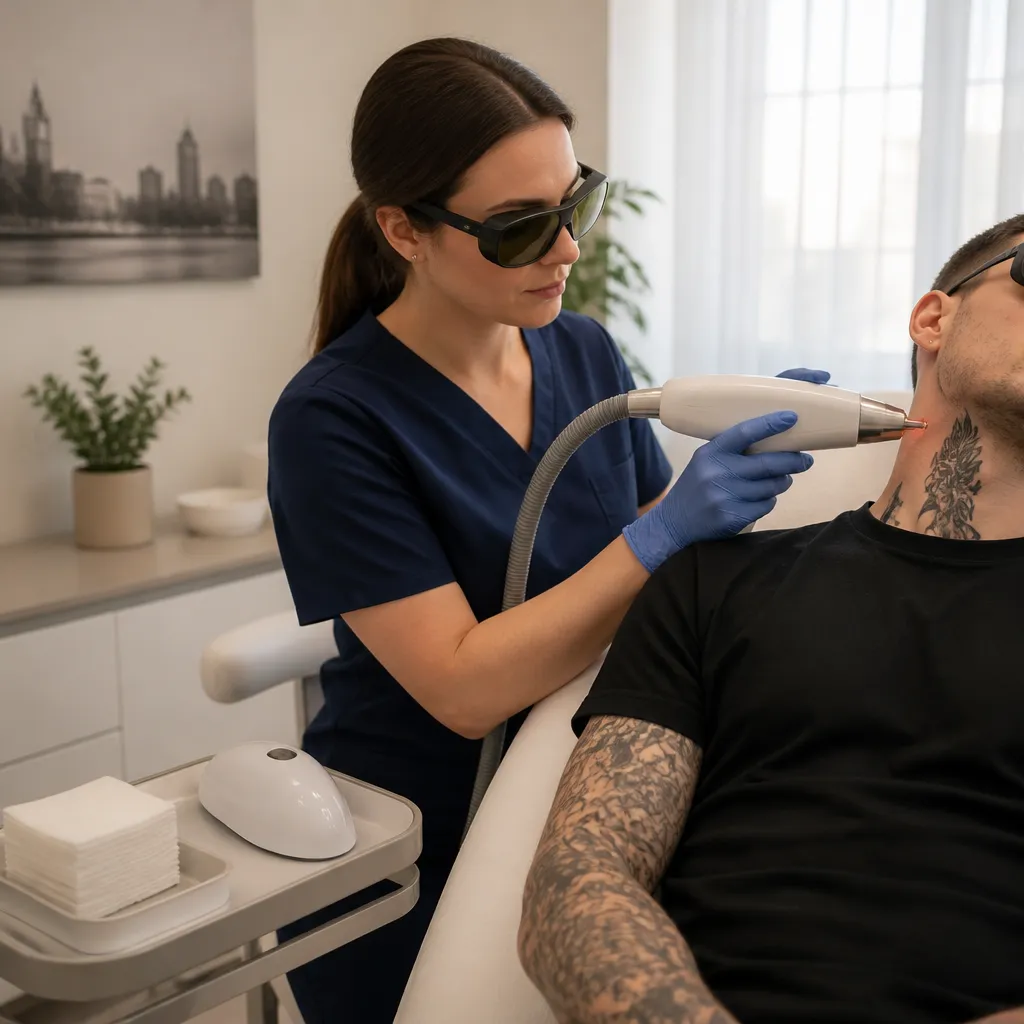
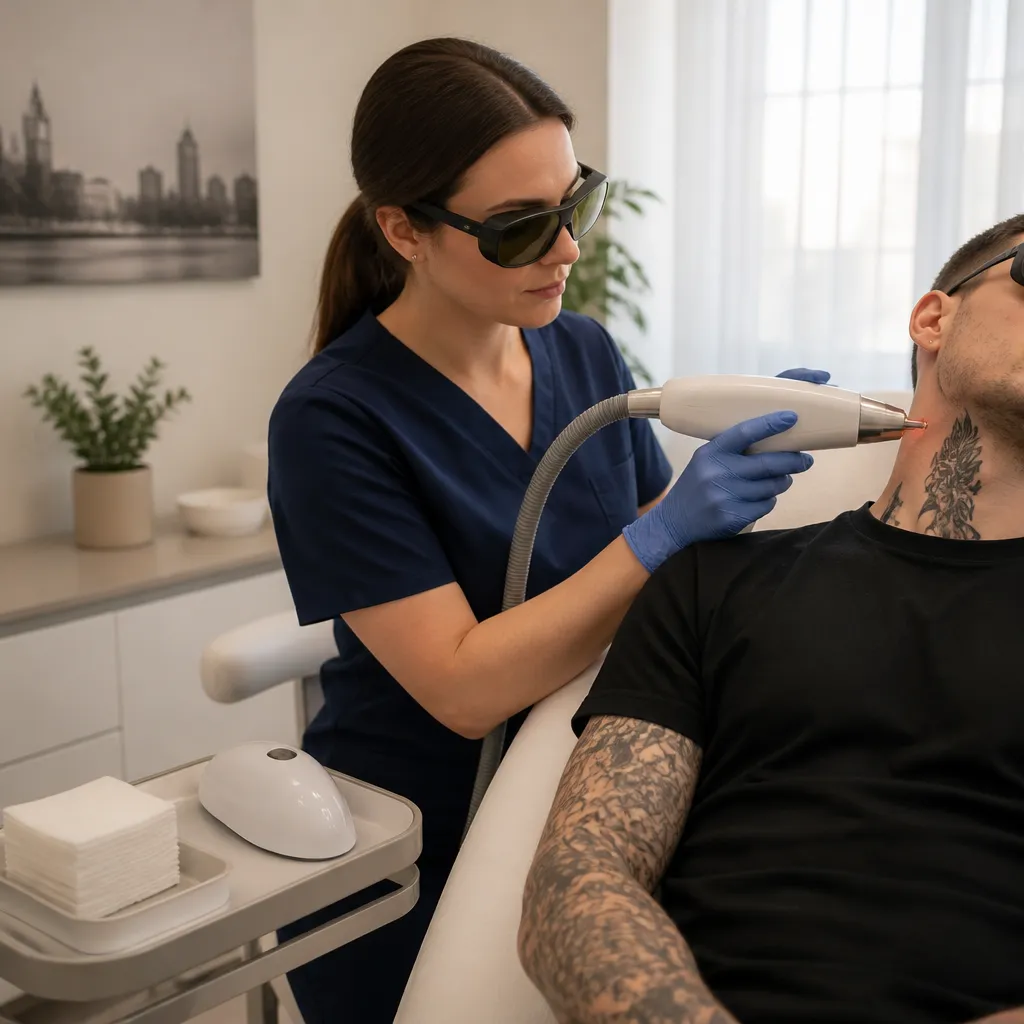
Topical numbing is common on the face, but it does not remove all sensation. Many clients describe each pulse as a quick snap, with warmth that builds across the session. The sensation is sharper on the chin than on fleshier areas, so be honest with your practitioner about how you are feeling.
On the face, the question is rarely whether the laser can break down the ink. The real question is whether the skin can recover between sessions.
Eye protection is not a formality. Government guidance on Q-switched lasers used for tattoo removal notes that tissue and blood may be ejected over some distance, so the operator and the client both need appropriate protection. Ask to see the eyewear before you sit down.
Pro tip: Eat something light beforehand and bring a cold pack for the journey home. Many people underestimate how warm the skin feels an hour after treatment.
Healing and Aftercare on the Face and Neck
Healing on the face usually looks worse on day two or three than it does on day one. Light crusting, mild swelling, and a tight feeling are normal. Spreading redness, discharge, or pain that gets worse rather than better should be reported to the clinic straight away.
The first 72 hours
Keep the area clean, apply the aftercare product you were given, and resist the urge to pick at crusts. Picking pulls at skin that is still repairing, and it is one of the most common causes of visible scarring we see after facial sessions.
Sleep on a clean pillowcase and avoid heavy sweating in the gym for a few days. Heat and friction irritate treated skin, and irritation can make the healing look patchy.
Sun, hair removal, and other facial treatments
Sun is the biggest threat to healing pigment. Unprotected exposure after a session can cause darkening, lightening, or uneven colour in the treated area. Use a high-factor sunscreen every day and cover the area in strong sun.
If you also book laser hair removal on the chin or neck, leave a clear gap before treating the same skin. Avoid other facial treatments, such as peels or microneedling, on the same area until your practitioner confirms that the skin has recovered.
Pro tip: Take a photo of the treated area at each visit, in the same light. Changes in colour and texture are much easier to judge when you can compare them side by side.
How Many Sessions and How Long It Takes
There is no single session count that fits every chin or neck tattoo. Ink age, depth, colour, size, and how much the skin reacts all influence the plan. Anyone who promises a fixed number after one look at the tattoo is guessing.

Why spacing matters more on the face
Sessions are spaced so the skin can settle and the body can clear the broken-down pigment. Shorter gaps may feel faster, but they raise the risk of irritation and scarring. On the face, longer gaps are usually the safer choice, even though they extend the overall timeline.
A rushed course can also make the next session less effective, because the skin has not recovered enough to respond evenly.
Realistic timelines for chin and neck work
Single-colour, older tattoos often respond well and may need fewer sessions. Multi-colour work and dense black areas packed with ink typically take more. Plan for a process that runs over months rather than weeks, and build that into your decision before you commit.
Recovery does not stop when the redness fades. Some clients notice that pigment continues to lighten for several weeks after a session, so judge progress across a few visits rather than after one.
Choosing the Right Removal Method
Not every method suits every tattoo. The right choice depends on the ink, your skin type, and how much visible scarring you can accept. Three approaches come up most often for chin and upper neck work.
Q-switched lasers for older, single-colour ink
Q-switched lasers have been used for tattoo removal for many years. They tend to work best on black and darker colours, and on facial skin they usually need several sessions with healing time in between.
Picosecond lasers for stubborn or multi-colour ink
Picosecond lasers deliver energy in much shorter pulses. Practitioners often use them on stubborn colours and mixed tattoos because they can break ink into finer particles. Results still depend on the ink, how your skin responds, and how many sessions the area has already had.
Surgical excision for small, contained tattoos
Excision cuts out the tattoo and closes the wound, so it can clear a small piece in one visit. It always leaves a scar. That is why we rarely recommend it on the chin or neck unless the tattoo is small and the scar can sit along a natural line.
| Approach | Best for | What to know |
|---|---|---|
| Q-switched laser | Older black and darker single-colour ink | Usually needs multiple sessions with healing gaps. Scarring risk stays low when spacing is right. |
| Picosecond laser | Stubborn, multi-colour, or resistant ink | Settings and spacing must suit facial skin. Results vary with ink type and skin response. |
| Surgical excision | Small, contained tattoos | Can remove a small piece in one visit, but leaves a scar. Rarely a good choice for larger or highly visible areas. |
Pro tip: Ask any clinic which laser type it plans to use and why. A clear answer tied to your specific ink is a much better sign than a machine name on a brochure.
Safety Checks and Practitioner Registration
Laser tattoo removal uses powerful equipment, and the rules around who can operate it are more specific than many people expect. Checking these points before you book protects you from avoidable problems.
What the registration rules say in England
In England, practitioners who use intense pulsed light (IPL), class 3B lasers, or class 4 lasers to treat a disease, disorder, or injury must register with the Care Quality Commission (CQC). Practitioners who use these devices exclusively for cosmetic purposes do not have to register with the CQC.
Some local councils in England also require practitioners using IPL and lasers to register with them. The official guidance says to check with your local council, so ask your clinic directly how it is registered and with which body.
Questions worth asking before you book
Ask who will operate the laser, how much experience they have with facial skin, and what happens if your skin reacts badly. A good clinic answers those questions without hesitation, explains its eye protection, and puts its aftercare advice in writing.
Council guidance notes on laser treatments also state that class 4 lasers and intense pulsed light sources can be used to remove tattoos, birthmarks, and other blemishes on the skin. The device is only part of the picture, so training and local rules matter just as much.
What Affects the Cost
Price is one of the first questions people ask, and it is the hardest to answer from a photo alone. At Faith Laser, we build packages around the individual rather than charging one fixed fee for every tattoo, because a small chin line and a dense black neck piece are very different jobs. Our complete tattoo removal approach carries a 98% effectiveness rate, with a focus on minimal skin damage, but results still depend on your ink and skin.

The factors that change your quote
Size, ink density, number of colours, age of the tattoo, and how your skin responds all change the number of sessions. More sessions means a higher total cost, so the cheapest first consultation is rarely the cheapest result.
Location also matters. Chin and neck work needs more care than many larger body areas, and that care takes time.
Getting a fair quote
Ask for a quote that lists the expected number of sessions, the recommended gap between them, and what happens if the tattoo responds more slowly than planned. A quote that only names a per-session price tells you very little about the total.
Pro tip: Ask for the quote in writing and compare it against the session plan. If the two do not match, ask why before you pay for anything.
Frequently Asked Questions
Does chin tattoo removal in Liverpool hurt more than removal on other areas?
Most clients find the chin more uncomfortable than fleshier areas such as the upper arm, because the skin is thin and sits over bone. Numbing helps, but expect a sharp snapping sensation during the pulses.
Is neck tattoo removal safe near the throat and jaw?
It can be, provided the practitioner uses proper eye protection, sets energy for your skin type, and avoids over-treating. Ask how the clinic protects the eyes and the skin around the jaw before your first session.
How many sessions will I need for a chin tattoo?
There is no fixed number. Ink density, colour, size, and skin response decide it, and most facial work runs over several months with healing time between sessions.
Can I have laser hair removal on my chin while the tattoo is being treated?
Not on the same skin straight away. Leave a clear gap, and ask your practitioner when it is safe to resume treatment on that area.
Do I need to check registration before having laser tattoo removal in England?
Yes, it is worth asking. In England, CQC registration applies to certain medical uses of IPL and lasers, and some councils require registration too, so ask the clinic how it is registered and with which body.
Will my chin or neck tattoo be fully removed?
Full removal depends on ink type, depth, and how the skin heals. Faith Laser states a 98% effectiveness rate for complete tattoo removal, but that is not a guarantee for every tattoo, so ask for an honest assessment at your consultation.
If you have had chin or neck tattoo removal in Liverpool, or you are weighing up your options now, we would love to hear what worked for you and what you wish you had known before your first session.
References
- Official guidance on registering laser and intense pulsed light treatments in England
- Government guidance on laser safety, including eye protection for Q-switched tattoo removal
- Council guidance notes on laser and intense pulsed light treatments
- Consumer article on what tattoo removal involves, costs, and feels like