

Underarm Laser Hair Removal Liverpool: Ditch the Razor
If you shave your underarms every two or three days and still find stubble by the weekend, you already know the problem. Razor burn, ingrown hairs, and the relentless repetition of it all add up to a genuinely irritating routine. Underarm laser hair removal in Liverpool is pulling more people away from that cycle every month, and once you understand how the treatment actually works, it is not hard to see why. This article breaks down everything you need to know before booking, from the science of hair growth cycles to aftercare, so you can make a genuinely informed decision rather than a hopeful one.
Table of Contents
- Quick Takeaways
- Why Liverpool Clients Are Switching
- How Underarm Laser Hair Removal Actually Works
- Razor vs. Waxing vs. Laser: An Honest Comparison
- What to Expect From Your Sessions
- Aftercare That Actually Matters
- Who Gets the Best Results
- Frequently Asked Questions
- References
Quick Takeaways
| Key Insight | Explanation |
|---|---|
| Most underarm treatments take under 15 minutes | The underarm area is small, making it one of the fastest laser treatment zones available. A session fits easily into a lunch break. |
| Laser only works during the anagen (growth) phase | At any point, only 10 to 20 percent of underarm hairs are in the active growth phase. Multiple sessions spaced 4 to 6 weeks apart are needed to catch each follicle at the right moment. |
| Most clients need 6 to 8 sessions for lasting results | This is the standard course for underarms. Some clients with finer or lighter hair may need additional sessions, while others with coarse, dark hair see results faster. |
| Laser eliminates ingrown hairs caused by shaving | By destroying the follicle rather than cutting the hair shaft, laser treatment removes the root cause of ingrown hairs and the associated dark spots they leave behind. |
| You can shave between sessions, but not wax or pluck | Shaving leaves the follicle intact for the laser to target. Waxing and plucking remove the hair root, making the subsequent session less effective. |
| The long-term cost is lower than a lifetime of waxing | Waxing appointments accumulate into a significant ongoing expense over years. A full laser course, once complete, requires only occasional maintenance if any at all. |
| Skin tone and hair colour affect how quickly results arrive | The laser targets melanin in the follicle. Coarse, dark hair on lighter skin responds fastest. Darker skin tones are fully treatable but require a specialist laser, such as an Nd:YAG, to work safely. |
Why Liverpool Clients Are Switching
The decision to stop shaving is rarely dramatic. It usually builds quietly: the third razor nick in a week, a holiday where you just wanted to feel comfortable in a sleeveless top without planning your shave schedule around it, or the realisation that you have spent years on a task that never actually ends. Underarm hair removal in Liverpool has become one of the most requested treatments at Faith Laser precisely because the underarms sit at that intersection of inconvenience and visibility.
Liverpool’s climate also matters in a practical sense. Between warmer months when people want to wear less and indoor venues that stay warm year-round, underarm confidence is not a seasonal concern. Clients report that the main motivator is not vanity but time. The routine of shaving every two to three days, managing irritation, and still not achieving consistently smooth skin is simply a poor use of effort for a permanent fix that exists.
There is also the skin health angle. Regular shaving with a blade drags across the skin surface repeatedly, causing micro-abrasions, folliculitis (inflamed hair follicles), and the dark patches that linger after ingrown hairs. Many clients who come to Faith Laser mention that improving the overall appearance and health of their underarm skin matters just as much to them as removing the hair itself.


How Underarm Laser Hair Removal Actually Works
The laser emits concentrated light energy that is absorbed by the melanin (pigment) inside the hair follicle. That absorbed energy converts to heat, which damages the follicle’s ability to produce new hair. The key word here is follicle. Shaving cuts the hair shaft at the skin’s surface. Laser treatment targets the structure beneath the skin that grows the hair in the first place.
Why Multiple Sessions Are Non-Negotiable
Hair does not all grow at the same pace or at the same time. Every follicle cycles independently through three phases: anagen (active growth), catagen (transition), and telogen (resting). The laser can only permanently disable a follicle when the hair is in the anagen phase, because that is when melanin concentration in the root is highest and the hair shaft is still physically attached to the follicle. At any given moment, research suggests that only around 10 to 20 percent of underarm hairs are in this active phase simultaneously.
This is not a flaw in the technology. It is simply biology. Spacing sessions 4 to 6 weeks apart is specifically designed to catch successive rounds of follicles entering the anagen phase. Trying to rush sessions together does not produce faster results because the follicles that were in telogen during your last session are simply not ready to be treated yet.
What the Sessions Actually Feel Like
Most clients describe the sensation as a brief snap or warmth on the skin, not unlike a small elastic band flick. The underarm area is small enough that a full treatment typically takes between 10 and 15 minutes. Modern laser systems include built-in cooling mechanisms that protect the surface skin and significantly reduce discomfort compared to older equipment. At Faith Laser, the technology used is specifically chosen for both effectiveness and client comfort.
The most important thing to understand about laser hair removal is that it works with your biology, not against it. Patience across a properly spaced course of sessions is what separates clients who are thrilled with their results from those who feel underwhelmed after just one or two treatments.
Pro tip: Shave the treatment area 24 hours before your session. This ensures the laser energy goes to the follicle beneath the skin rather than being partially absorbed by the hair shaft above the surface, which improves both safety and effectiveness.
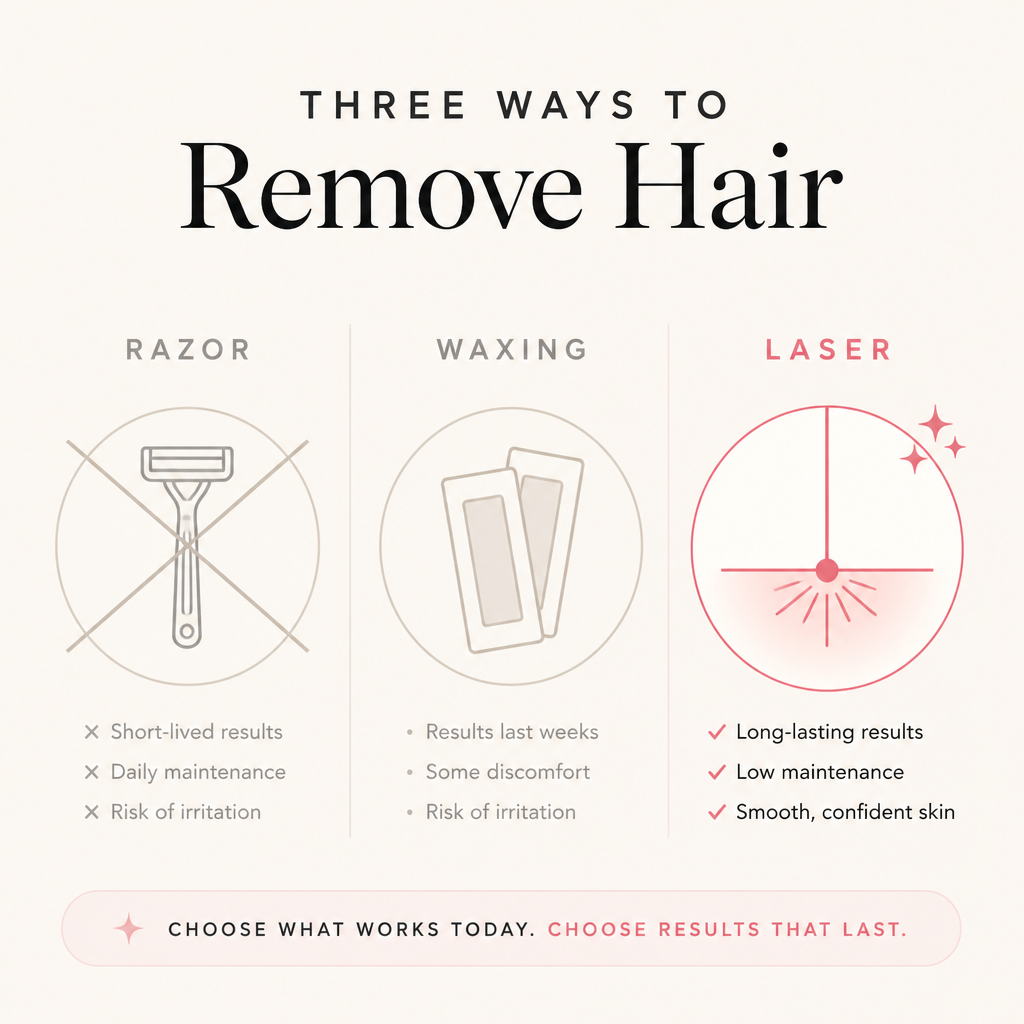
Razor vs. Waxing vs. Laser: An Honest Comparison
Choosing a hair removal method involves more than just upfront cost. The real question is what the method costs you in time, comfort, and skin health over months and years. Here is an honest look at how the three main approaches compare for the underarm area specifically.
| Method | How Long Results Last | Key Drawbacks for Underarms |
|---|---|---|
| Shaving | 1 to 3 days before visible regrowth | Razor burn, ingrown hairs, dark patches from repeated micro-abrasion, daily or near-daily time commitment |
| Waxing | 3 to 6 weeks, but you must let hair grow to a waxable length first | Pain during application, redness and irritation post-treatment, ingrown hairs, ongoing appointment costs that accumulate significantly over years |
| Laser Hair Removal | Long-term reduction after a full course; many clients see little to no regrowth | Requires 6 to 8 sessions over several months, upfront investment, not suitable for very light or grey hair without specialist assessment |
The practical reality of waxing for underarms is that it requires a growth phase before each appointment. That means a period of visible, unshaved hair before every session. For clients who want the option to wear sleeveless clothing at short notice, that constraint alone is enough of a reason to switch. Laser treatment, once completed, removes that planning burden entirely.
Pro tip: If you are comparing the total cost of laser against waxing, factor in the number of waxing appointments you have already had and project that forward over five to ten years. The long-term cost comparison almost always shifts decisively in favour of laser once the full course is complete.
What to Expect From Your Sessions
A typical course for underarm laser hair removal at Faith Laser runs across 6 to 8 sessions, spaced approximately 4 to 6 weeks apart. Here is what the progression generally looks like in practice.
Sessions 1 and 2: Noticing the Difference
After the first and second sessions, most clients report that regrowth comes back slower and in smaller quantities. The change is noticeable but not dramatic yet. This is completely normal. You are only catching a fraction of the follicles at this stage, and consistency at this point is critical.
Sessions 3 and 4: Visible Thinning
By the middle of a course, the hair that does regrow is typically finer and lighter in colour. The density decreases meaningfully. Many clients find they need to shave far less frequently between appointments, and some stop needing to at all in certain patches.
Sessions 5 to 8: The Finishing Phase
The later sessions target the most stubborn follicles. The hair that has persisted through earlier rounds tends to be finer or sitting in slower-cycling follicles. After completing this phase, the majority of clients achieve a long-term reduction that requires minimal or no maintenance. Some opt for a single top-up session annually, particularly after hormonal changes.
A consultation at Faith Laser before starting your course allows the team to assess your hair type, skin tone, and treatment goals and give you a realistic projection for your specific situation rather than a generic one.
Aftercare That Actually Matters
Aftercare is where a significant number of clients either reinforce or undermine their results. The rules are not complicated, but they are specific.
In the first 24 to 48 hours after a session, the skin in the treated area will be mildly sensitive. Hot showers should be avoided during this window because heat can further irritate skin that has just been treated. The same logic applies to saunas, steam rooms, and intense exercise that causes heavy sweating.
Avoid applying deodorant with strong chemical formulations on the day of your treatment and for at least 24 hours after. Opt for an unscented, gentle product if needed. Do not use exfoliants or active skincare ingredients such as retinol or AHAs on the treated area until any redness has fully subsided.
Between sessions, sun protection matters more than most clients expect. The treated skin is more photosensitive, and UV exposure can lead to pigmentation changes. Keep the underarm area out of direct sun where practical, and apply SPF if there is any chance of exposure.
A common mistake is stopping treatment early because the results after three or four sessions already feel good. Completing the full recommended course is what separates a long-term result from one that fades within a year as the untreated follicles cycle back into growth.
Pro tip: Keep a simple notes record of your session dates and any skin reactions you notice after each one. This makes it much easier for your practitioner to fine-tune settings for subsequent sessions and gives you an accurate picture of your own progress rather than relying on memory alone.
Who Gets the Best Results
The most straightforward cases for underarm laser hair removal are clients with coarse, dark hair on lighter skin tones. This combination gives the laser the clearest contrast to target, meaning the melanin in the follicle absorbs energy efficiently while surrounding tissue is largely unaffected.
However, laser hair removal in Liverpool at a clinic using modern technology is effective across a much broader range of skin tones and hair types than was possible with earlier generations of equipment. Darker skin tones are not excluded from treatment. They require a practitioner who selects the appropriate laser, specifically one operating at a wavelength that bypasses superficial skin pigment and targets the follicle deeper in the skin.
Where results are genuinely more limited is with very light blonde, red, or grey hair. The laser needs melanin to work, and hair with very low pigment does not give the laser enough to target effectively. If this applies to you, a consultation is still worthwhile to assess what is achievable.
Hormonal factors can also influence how the skin and follicles respond over time. Clients who are pregnant, breastfeeding, or undergoing significant hormonal changes may be advised to wait before starting or resuming a course. This is not a permanent barrier, just a timing consideration.
At Faith Laser in Liverpool, every client receives an individual assessment before treatment begins. The goal is to give you an honest picture of what your specific combination of hair type, skin tone, and treatment area can realistically achieve, so there are no surprises mid-course.
Frequently Asked Questions
How many sessions do I need for underarm laser hair removal?
Most clients need between 6 and 8 sessions for the underarms, spaced 4 to 6 weeks apart. This number can vary depending on hair colour and coarseness, skin tone, and how your individual follicles respond to treatment. Your practitioner at Faith Laser can give you a more precise estimate after your initial consultation.
Does underarm laser hair removal hurt?
The sensation is commonly described as a warm snap or a mild flick on the skin. The underarm area is small, so the treatment takes 10 to 15 minutes and most clients find it very manageable. Modern laser equipment includes cooling technology that reduces discomfort significantly compared to older machines.
Can I shave between laser sessions?
Yes. Shaving between sessions is fine and will not interfere with your results because it leaves the follicle beneath the skin intact for the laser to target. You should not wax, pluck, or use depilatory creams between sessions, as these methods remove or disrupt the hair root that the laser needs to be present to work effectively.
How long do the results of underarm laser hair removal last?
After a complete course of treatment, many clients experience long-term reduction with little to no regrowth. Some find that the odd maintenance session once every 12 months keeps results consistent, particularly following hormonal changes such as pregnancy. The results are not technically permanent in a guaranteed-forever sense, but they are dramatically longer lasting than any form of shaving or waxing.
Is underarm laser hair removal suitable for darker skin tones?
Yes, with the right equipment and a practitioner experienced in treating a range of skin tones. Darker skin requires a laser operating at a longer wavelength, such as an Nd:YAG, to safely bypass melanin in the skin surface and target the follicle specifically. At Faith Laser, the treatment approach is adapted to the individual, not applied as a one-size-fits-all protocol.
What should I do before my first underarm laser session?
Shave the area 24 hours before your appointment. Avoid applying deodorant or any scented products on the day of treatment. Do not wax, pluck, or use depilatory creams in the weeks leading up to your first session, as the hair root needs to be present in the follicle for treatment to work. Arrive with clean, product-free skin in the underarm area.
Why does Faith Laser recommend a consultation before starting treatment?
A consultation allows the team to assess your hair type, skin tone, and treatment goals and to identify any factors that might affect your results or the approach needed. It also gives you the opportunity to ask questions and understand exactly what the course involves before committing to anything. This step removes guesswork and sets realistic expectations from the start.
Have you already tried laser hair removal on your underarms, or are you weighing up whether it is the right step? Share your experience or questions below and help others who are considering making the switch.
References
- Guide to how many laser sessions are needed for underarm hair removal and how the hair growth cycle affects treatment
- Overview of underarm laser hair removal sessions, hair growth phases, and factors affecting results
- Underarm laser hair removal sessions guide covering the anagen phase and what clients experience at each stage
- Comparison of underarm laser hair removal versus waxing including pain, cost, and long-term skin outcomes
- Clinical overview of underarm laser hair removal benefits, results, and aftercare recommendations