Is Laser Hair Removal Permanent? The Honest Answer
You’ve probably seen the phrase “permanent hair removal” used to describe laser treatments, and then read the small print that says “results may vary.” That contradiction is exactly why so many people in Liverpool arrive at their first consultation genuinely confused. So here is a straight answer: laser hair removal is not the same as permanent hair elimination, but it delivers something that, for most people, is the next best thing. Understanding the precise difference, and knowing what drives your personal result, is what separates clients who feel thrilled with their outcome from those who feel misled.
Table of Contents
- What “Permanent” Actually Means in Laser Hair Removal
- How Laser Hair Removal Works
- Why Multiple Sessions Are Non-Negotiable
- Factors That Affect Your Results
- Comparing Hair Removal Methods: Laser vs. Alternatives
- Maintenance Sessions: What to Expect Long-Term
- Laser Hair Removal in Liverpool: What to Look For
- Frequently Asked Questions
- References
What “Permanent” Actually Means in Laser Hair Removal
The term “permanent hair reduction” has a specific regulatory meaning. According to FDA device documentation, it refers to a long-term, stable reduction in the number of hairs that regrow after a completed treatment regimen. It does not mean every single hair follicle is guaranteed to stop producing hair forever. That distinction matters enormously when you are setting expectations before your first session.
When the laser completely destroys a follicle, that follicle cannot produce hair again. That part is genuinely permanent. The complication is that not every follicle is fully destroyed during a course of treatment, and entirely new follicles can be activated later in life by hormonal changes. So the honest picture is this: a large proportion of your treated hair is gone for good, but you are not immune to new growth triggered by biology.
Laser hair removal is permanent when the hair follicle is destroyed. When the hair follicle is only damaged, the hair will eventually regrow. The amount of time it takes for the hair to regrow depends on the person’s unique hair growth cycle.
This is not a reason to avoid treatment. It is a reason to go in with accurate expectations and to choose a clinic that explains this upfront rather than glossing over it with marketing language.
How Laser Hair Removal Works
The mechanism is straightforward once you understand the target. Laser hair removal works by directing concentrated light energy at the melanin pigment inside each hair follicle. The light travels down the hair shaft and converts to heat inside the follicle itself, damaging or destroying the structure that generates new growth.
The Role of Melanin
Melanin is the pigment that gives both hair and skin their colour. The laser is calibrated to absorb into the melanin in the hair, not the surrounding skin tissue. This selective targeting is what makes modern laser systems both effective and safe when operated correctly. Darker, coarser hair contains more melanin and therefore absorbs laser energy more efficiently, which is why it tends to respond fastest to treatment.
What Happens to the Follicle
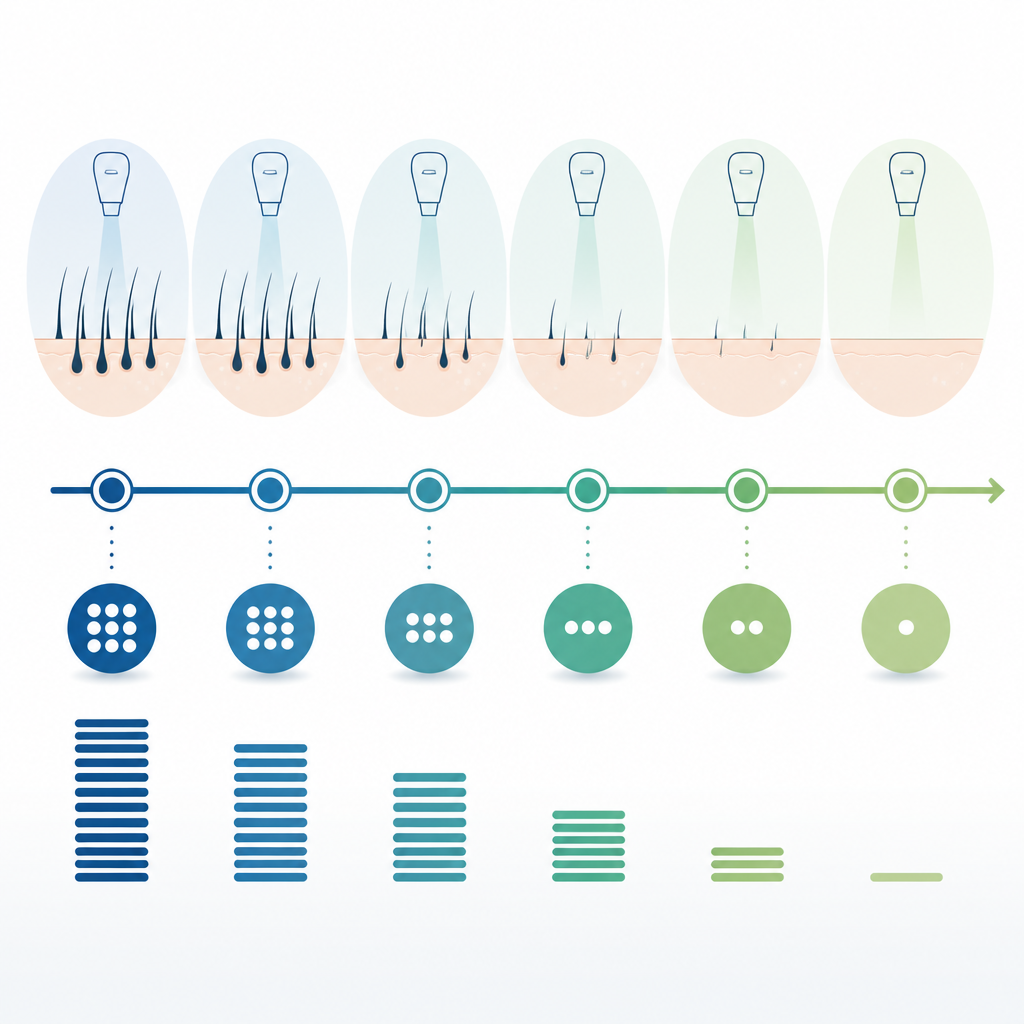
The heat generated inside the follicle is enough to disable or destroy the cells responsible for hair production. A fully destroyed follicle produces no further hair. A damaged but surviving follicle may produce hair again, though it typically regrows finer and lighter than before. This is why results across a full course of treatment accumulate progressively: each session destroys more follicles and weakens others further.
Pro tip: Always attend your sessions with the treatment area cleanly shaved the day before. The laser needs to travel down the hair shaft to reach the follicle. Long surface hair wastes laser energy and increases surface skin discomfort rather than targeting the root.
Why Multiple Sessions Are Non-Negotiable
The single most misunderstood aspect of laser hair removal is why one session is never enough, no matter how powerful the equipment. The answer lies entirely in the hair growth cycle.
The Three Phases of Hair Growth
Every hair follicle cycles through three distinct phases: the anagen phase (active growth), the catagen phase (transition), and the telogen phase (resting and shedding). Laser hair removal is only effective during the anagen phase, because this is the only stage when the hair shaft is fully connected to the follicle and the melanin concentration is highest.
At any given moment, only roughly 10 to 20 percent of your hair follicles are in the anagen phase simultaneously. This means a single session, no matter how well performed, can only target that fraction of follicles. The rest are in phases the laser cannot effectively address. You need multiple sessions, spaced correctly, to catch successive waves of follicles as they enter the anagen phase.
How Many Sessions Should You Expect?
Most clients need between 6 and 8 sessions to achieve significant permanent reduction across a treated area. Some areas of the body, particularly those sensitive to hormonal fluctuation such as the chin and bikini line, may require additional sessions. After the first session, most people see roughly a 10 to 25 percent reduction in hair regrowth. By the end of a full course, the cumulative reduction is substantial.
Pro tip: Session spacing matters as much as session count. Stick to the intervals recommended by your practitioner. Going too long between sessions allows previously targeted follicles to recover, while going too short misses the follicles that were not yet in the anagen phase at your last appointment.
Factors That Affect Your Results
Laser hair removal is not a one-size-fits-all treatment. Several factors determine how dramatic and how long-lasting your reduction will be.
Hair Colour and Thickness
Coarse, dark hair responds best because it contains the most melanin for the laser to target. Fine, fair, or grey hair contains too little melanin for standard laser systems to absorb effectively. If you have light-coloured hair, be honest with your practitioner before investing in a course of treatment. They should advise you accurately on what to expect rather than oversell results.
Skin Tone and Laser Type
Different laser wavelengths are suited to different skin tones. The diode laser (around 810 nm) and the Nd:YAG laser (1064 nm) are both considered appropriate for a wider range of skin types, including darker skin tones. The Nd:YAG laser in particular offers deeper penetration with reduced risk to the surface skin, making it the preferred choice for clients with darker complexions. A reputable clinic will use the correct wavelength for your specific skin type rather than applying a single device to every client.
Hormonal Changes
Hormones are the most common reason hair returns after a completed course. Pregnancy, menopause, polycystic ovary syndrome (PCOS), and changes to hormonal medications can all stimulate dormant follicles or activate entirely new ones, particularly in hormone-sensitive zones like the face, chin, and bikini area. Any regrowth driven by hormonal change tends to be finer and lighter than original hair, but it can still appear. This is the primary reason some clients choose periodic maintenance sessions.

Comparing Hair Removal Methods: Laser vs. Alternatives
To understand why permanent hair removal in Liverpool via laser has become the default choice for people serious about long-term results, it helps to look honestly at the alternatives.
| Method | Duration of Results | Key Limitations |
|---|---|---|
| Laser Hair Removal | Long-term to permanent reduction across treated follicles; occasional maintenance may be needed | Requires multiple sessions; less effective on fine, light, or grey hair; hormonal regrowth possible |
| Waxing / Shaving / Threading | Days to a few weeks; no permanent follicle damage | Ongoing cost, time, and discomfort for life; risk of ingrown hairs; no reduction in follicle activity |
| Electrolysis | Permanent when every follicle is individually treated | Treats one follicle at a time; extremely time-consuming and expensive for large areas; practical only for very small zones |
In practice, laser hair removal occupies the most practical middle ground for anyone treating a body area larger than a small patch. It covers large areas efficiently, delivers cumulative permanent reduction, and any residual regrowth is meaningfully finer than the original hair. Electrolysis is technically more “permanent” in a strict sense, but the time and cost required to treat every follicle individually makes it unrealistic for most treatment areas.
Maintenance Sessions: What to Expect Long-Term
After completing a full treatment course, most people find that maintenance is minimal rather than ongoing. The occasional top-up session, when new growth appears, is far less frequent than the initial course. How often this happens varies significantly by body area and individual biology.
Hormone-sensitive areas such as the upper lip, chin, and bikini line tend to require attention sooner than areas like the underarms or legs. Areas on the legs or back may go years without any visible regrowth. Any hair that does return after a completed course is typically finer and lighter than the original growth, because the laser has already changed the nature of those follicles even if it did not fully destroy them.
A common mistake is abandoning a course of treatment midway through and then concluding that laser “doesn’t work.” A partial course leaves many follicles damaged but alive. Completing the full recommended number of sessions is what makes the difference between impressive long-term results and disappointing partial ones.
Pro tip: Keep a record of when you notice any new growth after completing your course. If you log the area and approximate timing, your practitioner can target top-up sessions precisely rather than retreating the entire area unnecessarily.
Laser Hair Removal in Liverpool: What to Look For
Liverpool clients have more options than ever for laser treatment, which makes it more important to choose on the basis of quality rather than convenience or price alone. There are specific things that separate a clinic delivering genuine long-term results from one simply running bodies through a machine.
Proper Skin and Hair Assessment
Any clinic worth your time will conduct a thorough consultation before your first session. This should include an honest assessment of your hair colour and texture, your skin tone, your medical history, and any hormonal factors that might influence your outcome. If a clinic skips this and simply books you in for a standard package without personalising it, that is a red flag.
The Right Equipment for Your Skin Type
As covered above, not every laser suits every skin tone. Confirm that your chosen clinic uses equipment appropriate for your skin and hair combination. A practitioner who genuinely understands the technology will explain which wavelength they are using and why it is the right choice for you specifically.
Transparent Expectations
The most important quality in a laser clinic is honesty about outcomes. A practitioner who promises you complete, permanent elimination of every hair is either misinformed or misleading you. The correct promise is a significant, long-lasting reduction that, for most clients, feels life-changing in practice. At Faith Laser, the approach is built around tailored packages, transparent communication, and a relaxed environment where clients can ask exactly these questions before committing to a course of treatment.
Whether you are looking at laser hair removal for underarms, the bikini line, facial areas, or larger body zones, the combination of the right technology and an experienced practitioner is what separates a transformative result from a disappointing one. Liverpool clients also have access to tattoo removal and other advanced treatments at the same clinic, making it straightforward to address multiple concerns in one place.
Frequently Asked Questions
Is laser hair removal actually permanent?
Laser hair removal delivers what is correctly called permanent hair reduction, not permanent hair elimination. Follicles that are fully destroyed by the laser cannot regrow hair. However, not every follicle is guaranteed to be fully destroyed across a course of treatment, and hormonal changes later in life can activate new follicles. The practical result for most people is a dramatic, long-lasting reduction with any regrowth being finer and lighter than the original hair.
How many sessions do I need for laser hair removal?
Most people need between 6 and 8 sessions to achieve significant reduction across a treated area. This is because the laser is only effective during the anagen (active growth) phase of the hair cycle, and only around 10 to 20 percent of follicles are in that phase at any one time. Multiple sessions, spaced at the correct intervals, allow practitioners to treat successive waves of follicles as they enter the anagen phase.
Will the hair grow back after laser hair removal?
In many follicles, no. Hair from fully destroyed follicles does not grow back. However, hormonal changes such as pregnancy, menopause, or PCOS can stimulate new or dormant follicles to produce hair, particularly in hormone-sensitive areas. Any regrowth that occurs after a completed course tends to be finer and lighter than original hair. Occasional top-up sessions can address this without repeating a full course.
Does laser hair removal work on all skin and hair types?
Laser hair removal works best on dark, coarse hair against lighter skin because the contrast makes it easier for the laser to target melanin in the follicle. However, modern laser systems, particularly the diode and Nd:YAG wavelengths, are effective across a broader range of skin tones including darker complexions. Very fine, light blonde, red, or grey hair contains too little melanin for standard laser systems to target effectively. A proper consultation should assess whether laser is the right option for your specific combination.
Is laser hair removal safe for sensitive areas?
Yes, when performed by trained practitioners using appropriate equipment. Areas such as the underarms, bikini line, and face are all routinely treated with laser. The key is using the correct laser settings and wavelength for the skin tone and hair type in that specific area. Sensitive areas may also be more subject to hormonal regrowth over time, making them candidates for occasional top-up sessions after the initial course.
How long do laser hair removal results last?
For many clients, results in non-hormonal areas last for years without any touch-up treatment. For hormone-sensitive areas, some maintenance may be needed every year or so, or following significant hormonal shifts such as pregnancy. The longevity of results depends heavily on completing the full recommended course of sessions. A partial course produces partial and shorter-lasting results, while completing all recommended sessions significantly extends how long you go without regrowth.
Have you had laser hair removal or are you currently considering it? Share your experience or questions below. We would love to hear what matters most to you when thinking about a treatment like this.
References
- Medical News Today: How laser hair removal works, its permanence, and what affects results
- Cleveland Clinic: Laser hair removal treatment overview including effectiveness and safety
- National Institutes of Health: Laser hair removal on darker skin types, wavelength selection and efficacy
- National Institutes of Health: Clinical study on multi-wavelength laser hair removal across Fitzpatrick skin types