Most people asking how long does tattoo removal take expect a single answer. The honest reply is: between a few months and a couple of years, depending on factors that are entirely specific to your tattoo. That range is not a cop-out. It reflects genuine clinical reality. The colour, depth, age, and origin of your ink all determine how many sessions you need, and those sessions are spaced weeks apart to give your immune system time to flush out the fragmented particles. If a clinic promises you a fixed number of sessions in your very first conversation, without examining the tattoo closely, treat that as a red flag. At Faith Laser in Liverpool, every removal journey starts with a proper assessment because realistic expectations matter as much as the treatment itself.
| Key Insight | Explanation |
|---|---|
| Most tattoos need 6 to 12 sessions | The exact number depends on ink colour, depth, density, and your skin’s immune response. There is no universal fixed number. |
| Sessions must be spaced 6 to 8 weeks apart | Your body needs this time to clear the fragmented ink particles naturally. Shortcutting this gap reduces results and risks skin damage. |
| Black ink clears fastest | Black absorbs all laser wavelengths, making it the most responsive colour. Green, blue, and yellow are significantly harder to shift. |
| Amateur tattoos often clear quicker than professional ones | Shallower placement and lower ink density mean fewer sessions, even though professional work looks more polished. |
| Cover-up tattoos take the longest | Two layers of dense ink effectively double the removal challenge. Expect the higher end of the session count, or beyond it. |
| Tattoo location affects speed | Tattoos on the neck, chest, and upper body fade faster. Hands, feet, and ankles are the slowest due to poorer circulation. |
| Older tattoos are generally easier to remove | The body has already started breaking down the ink naturally, so the laser has less work to do from the first session. |
Understanding these variables upfront prevents the single most common frustration in tattoo removal: expecting it to be over sooner than it realistically will be. The clients who get the best outcomes are those who go in with accurate information, commit to the full course of treatment, and follow aftercare properly between sessions.
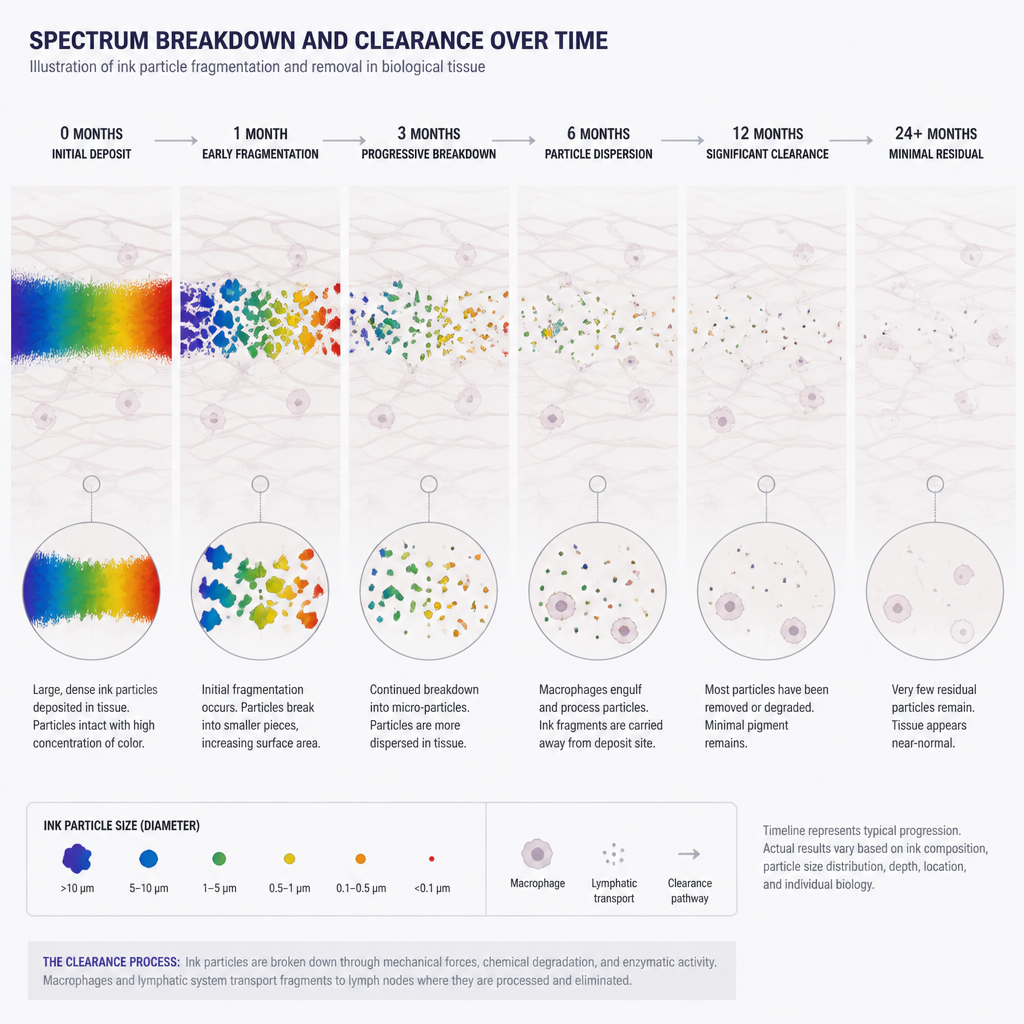
The process is part laser, part immune system. The laser delivers concentrated energy that shatters tattoo ink into tiny particles. Once those particles are small enough, your body’s immune system, specifically the blood and lymphatic system, flushes them away naturally. Each session breaks down another layer of ink, and then your body needs time to clear what was just fragmented before the next session makes sense.
This is why you cannot simply book sessions back-to-back and finish faster. Spacing sessions 6 to 8 weeks apart is not a scheduling convenience. It is a clinical requirement. Going too soon means the laser is working on skin that still contains the last round of fragmented particles, which reduces effectiveness and increases the risk of adverse reactions.
Different ink colours require different laser wavelengths to respond properly. A single-wavelength laser will be effective on some colours and largely ineffective on others. This is one reason why the technology used at your clinic matters. At Faith Laser, the equipment is selected specifically for its ability to treat a wide range of ink colours at varying depths, which is part of why the clinic achieves the results it does for Liverpool clients.
Pro tip: Ask your clinic which laser wavelengths their equipment uses before committing. If they can only treat one or two colours effectively, a multi-colour tattoo will plateau early and you will be left with a partial result.
The single most useful way to set realistic expectations is to look at your specific tattoo type. Each category has its own typical session range, though these ranges are estimates, not guarantees.
These are typically the fastest to clear. Because the ink is applied shallowly and inconsistently, without a professional machine, the density is lower and the depth is less uniform. Expect somewhere in the range of 4 to 6 sessions for significant to full clearance. At 6 to 8 weeks between each session, this means a realistic total timeline of roughly 6 to 12 months.
A well-executed professional tattoo in black ink sits deeper and more uniformly in the dermis than amateur work. Black ink is, however, the most responsive to laser treatment because it absorbs all wavelengths. Expect 6 to 8 sessions for most single-colour professional pieces. Total timeline: approximately 9 to 16 months, accounting for the gaps between sessions.
Each colour in a tattoo requires a specific laser wavelength to respond. Multi-colour tattoos therefore demand more technical precision per session and typically more sessions overall. Colours like green, blue, and yellow are among the most resistant to laser treatment. A multi-colour sleeve or large piece could realistically require 8 to 12 sessions or more. Total timeline: 12 to 24 months is not unusual.
Cover-up tattoos are the most demanding cases in tattoo removal. There are effectively two layers of ink to clear, and the top layer is usually a darker, denser design applied specifically to obscure what is underneath. These can require significantly more sessions than a comparable single tattoo and represent the upper end of any realistic timeline. If you are trying to remove a cover-up, build your expectations around the higher end of the range and then some.
Older tattoos where the ink has already begun to fade naturally are generally easier to treat. The body has already started the breakdown process, which means the laser has less work to do from session one. An old, faded tattoo in black or dark colours could clear in as few as 4 to 6 sessions, depending on how much ink remains.
The body is doing the real work between sessions. The laser just gives it something to work on. Every session removes a layer, and the cumulative effect over months is where the transformation happens.
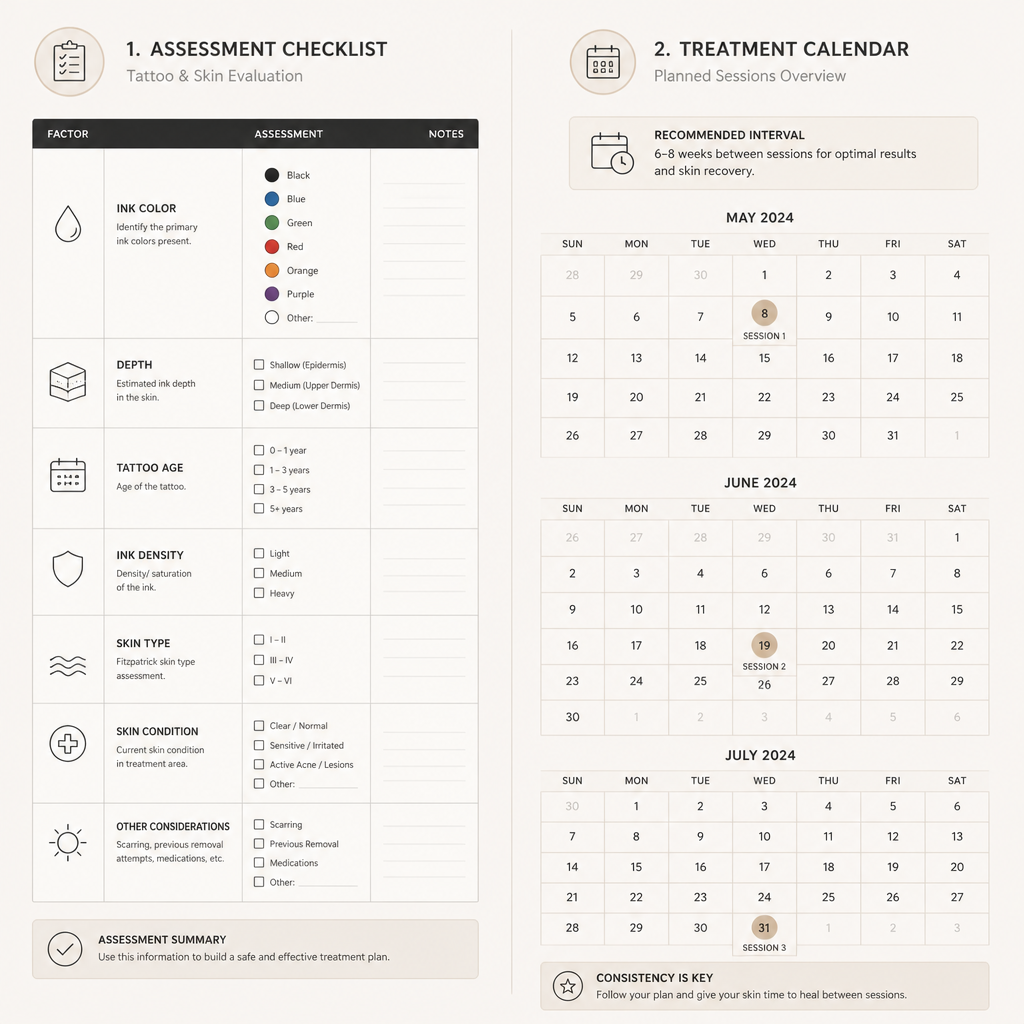
The Kirby-Desai Scale is a clinical assessment tool used in tattoo removal to estimate how many sessions a specific tattoo is likely to need. It scores six factors, each of which influences removal difficulty in a measurable way. Understanding these factors helps you go into a consultation with the right questions.
Lighter skin tones generally require fewer sessions. This is because the laser can be set to a higher energy level without risk of affecting the surrounding skin pigment. Darker skin tones require more careful calibration to protect melanin, which can mean lower energy settings and more sessions to achieve the same clearance.
Areas closer to the heart and major blood vessels clear ink faster because the immune response is stronger there. Tattoos on the head, neck, and chest tend to fade more quickly than those on the feet, ankles, or hands, where circulation is slower. If your tattoo is on your wrist or ankle, build extra sessions into your expectations.
Black ink is the most responsive because it absorbs all laser wavelengths. Red responds reasonably well. Green, blue, and yellow are the hardest to treat and require specific wavelengths that not all lasers provide. A single-colour black tattoo and a multi-colour piece of the same size can have very different session counts purely because of the colours involved.
Professional tattoos are applied with machines that deliver ink consistently into the dermis at a uniform depth. This makes them more durable but also more resistant to removal because the ink is densely packed. Amateur tattoos, with uneven application and shallower placement, often respond faster.
If the original tattoo caused scarring, or if the skin never healed properly after tattooing, ink embedded in scar tissue is harder to shift. The laser interacts differently with scar tissue than with healthy skin, and complete removal is harder to guarantee in these cases.
Older tattoos, where ink has already begun to fade naturally, sometimes clear faster than fresh, densely saturated tattoos. The natural degradation of the ink gives the laser a head start.
Pro tip: Before your first session at any clinic, ask for a written estimate of the likely session range based on these six factors. A clinic that gives you a single number without qualification is guessing. A clinic that gives you a range, with an explanation of why, is operating properly.
Not all laser tattoo removal is the same. The technology used, the expertise of the practitioner, and the session protocol all affect how fast you progress and what your skin looks like at the end. Here is a straightforward comparison of the main approaches you will encounter when researching clinics in Liverpool and beyond.
| Approach | Typical Session Count | What You Need to Know |
|---|---|---|
| Q-Switched Laser (standard) | 6 to 20 sessions depending on tattoo complexity | The long-established clinical standard. Highly effective on black and dark inks. More sessions needed for resistant colours like green and blue. Widely available. |
| Picosecond Laser (advanced) | Generally fewer sessions than Q-switched for equivalent tattoos | Delivers energy in shorter pulses, which can shatter ink into smaller particles more efficiently. Clinical reviews support faster clearance in many cases, particularly for multi-colour tattoos. Not all clinics have this technology. |
| Multi-wavelength systems | Depends on tattoo; can reduce total sessions for multi-colour work | The ability to switch wavelengths within a single session means each ink colour gets the right treatment. Essential for efficient removal of anything beyond black and red. Ask specifically whether the clinic’s laser handles green and blue. |
The technology gap between clinics is real. A clinic using an older, single-wavelength system will take longer to clear a complex multi-colour piece than a clinic with a modern multi-wavelength setup. When you are comparing options for laser tattoo removal in Liverpool, ask specifically what equipment is being used, not just what service is offered. Faith Laser invests in advanced laser technology to ensure that clients are not paying for more sessions than necessary.
The period between sessions is where most of the visible progress happens, but it is also the phase most people underestimate. Immediately after a session, the treated area will typically appear red, slightly raised, and sensitive, much like a mild sunburn. This usually settles within a few days.
Over the following weeks, the skin will gradually show fading as your immune system processes and removes the fragmented ink. This fading is cumulative. The difference after session one may be subtle. By session four or five, the difference is usually striking. Clients who drop out after two or three sessions because progress feels slow are often walking away right before the results become most visible.
Sun exposure to the treated area between sessions is one of the main things that slows progress and increases the risk of complications. Avoid direct sun on the tattoo site and use a high-SPF sunscreen if the area is exposed. If you work outdoors and covering the area is not practical, it may be worth timing your removal course around the seasons, starting in autumn or winter when UV exposure is lower.
Knowing what not to do is as important as understanding the process itself. These are the errors that add sessions and months to a removal timeline unnecessarily.
Booking sessions too close together. The 6 to 8 week gap is there for a reason. Rushing sessions does not accelerate results. It prevents the immune system from clearing the previous round of fragmented ink before the next session begins, which means each session is less effective than it should be.
Choosing a clinic based on price alone. Cheaper sessions sometimes mean fewer wavelengths available, less experienced practitioners, or lower-energy settings to reduce skin risk on aging equipment. A shorter, more effective course of treatment at a well-equipped clinic like Faith Laser often works out more cost-effective than a longer course at a budget provider.
Neglecting aftercare. Picking at blistering skin, exposing the treated area to direct sun, or using products on the area that were not recommended by your clinic can all cause complications that add time to the process, or cause scarring that makes full removal harder.
Expecting linear progress. Tattoo fading is not a straight line. Some sessions produce dramatic visible change. Others seem to produce less, while the body is actually processing ink that will become visible in the following weeks. Trust the process and complete the course.
A small tattoo in black ink, whether amateur or professional, typically requires between 4 and 8 sessions spaced 6 to 8 weeks apart. That puts the total timeline at roughly 6 to 16 months. The specific number depends on how deeply and densely the ink was applied. An amateur design will generally clear at the lower end; a professionally done piece with dense black ink will take longer.
Complete removal is achievable for the majority of tattoos, particularly black and dark-ink designs on lighter skin tones. Some tattoos, especially those with certain colours like green and blue, or those sitting in scarred tissue, may leave a faint shadow or slight skin texture change. At Faith Laser, the clinic achieves 98% effectiveness for complete removal, which reflects both the quality of the technology used and the skill with which treatments are delivered.
Yes, significantly. Black ink absorbs all laser wavelengths and is the most straightforward to treat. Colours like red respond reasonably well. Green, blue, and yellow are the most resistant and require specific wavelengths to respond at all. A multi-colour tattoo of the same size as a black tattoo will almost always require more sessions. This is one of the key reasons why the equipment a clinic uses directly affects your timeline.
The laser breaks ink down into tiny particles, but your body’s immune system does the actual removal work, carrying those particles away through the blood and lymphatic system. This process takes weeks. If you book another session before your body has had time to clear the previous round of fragmented ink, the laser is working on skin that has not yet processed the last treatment. The result is reduced effectiveness and greater skin stress. Six to eight weeks is the clinically supported minimum gap.
Yes. Areas closer to the heart and major blood vessels have stronger circulation, which means the immune system clears fragmented ink more efficiently from those areas. Tattoos on the head, neck, and upper chest tend to fade fastest. Tattoos on the feet, ankles, and hands are the slowest to respond because circulation in the extremities is weaker. If your tattoo is on your wrist or ankle, factor in additional sessions compared to the same tattoo on your upper arm or chest.
A credible clinic will give you a session range, not a fixed number, and will be able to explain that range by reference to the specific characteristics of your tattoo: its colours, size, depth, age, and location on your body. If a clinic guarantees removal in a specific number of sessions at an initial phone call without looking at the tattoo, that is a promise they cannot honestly keep. At Faith Laser, the assessment process is built around giving clients a realistic, personalised estimate so there are no unwelcome surprises mid-treatment.
Have you started a tattoo removal course, or are you still weighing up your options? Share your experience or questions below, and our team will be happy to help.