Tattoo Removal and Scar Tissue: What Liverpool Clients Need
Most Liverpool clients who come in for tattoo removal ask the same question first: will my scar stop the ink from fading? The honest answer is that scar tissue changes the picture, though rarely in the way people fear. When skin has healed from a tattoo, a repair scar, an old burn or a keloid, the way light and pigment interact shifts. Understanding that before your first session helps you set realistic expectations, spot warning signs early and avoid paying for treatment that will not help. This guide covers tattoo removal scar tissue Liverpool clients should understand, from how scars form to when to wait.
Table of Contents
- Quick Takeaways
- How Scar Tissue Forms Under a Tattoo
- Can Laser Removal Work on Scarred Skin?
- Allergic Reactions That Mimic Scarring
- Pigmentation Changes and Skin Tone Risks
- What a Proper Scar Consultation Checks
- Comparing Removal Approaches for Scarred Tattoos
- Aftercare for Treated Scar Tissue
- Frequently Asked Questions
- References
Quick Takeaways
| Key Insight | Explanation |
|---|---|
| Scar tissue slows removal but rarely blocks it | Raised or thickened scars usually need more sessions and gentler settings. A proper consultation shows whether the scar is stable enough to treat. |
| Disclose any keloid history first | Keloid-prone skin can react badly to new trauma, including laser energy. Mention keloids, burns and slow-healing cuts before anyone picks settings. |
| Itchy or raised ink may be a reaction, not a scar | Persistent itching, firm bumps or swelling can signal an allergic or inflammatory response. Get it checked by a doctor before booking treatment. |
| Red ink needs extra scrutiny | Red pigments are one of the most common culprits in tattoo allergies and can cause photosensitivity. Tell your practitioner which colours you have. |
| Wait for the scar to settle | Treat a scar once it is fully closed and no longer red, warm or itchy. Treating inflamed skin is the most common route to blistering and new marks. |
| Protect the skin from sun before and after | Tanned or darker skin is more prone to pale or dark patches after treatment. Cover the area and use sunscreen throughout the process. |
How Scar Tissue Forms Under a Tattoo
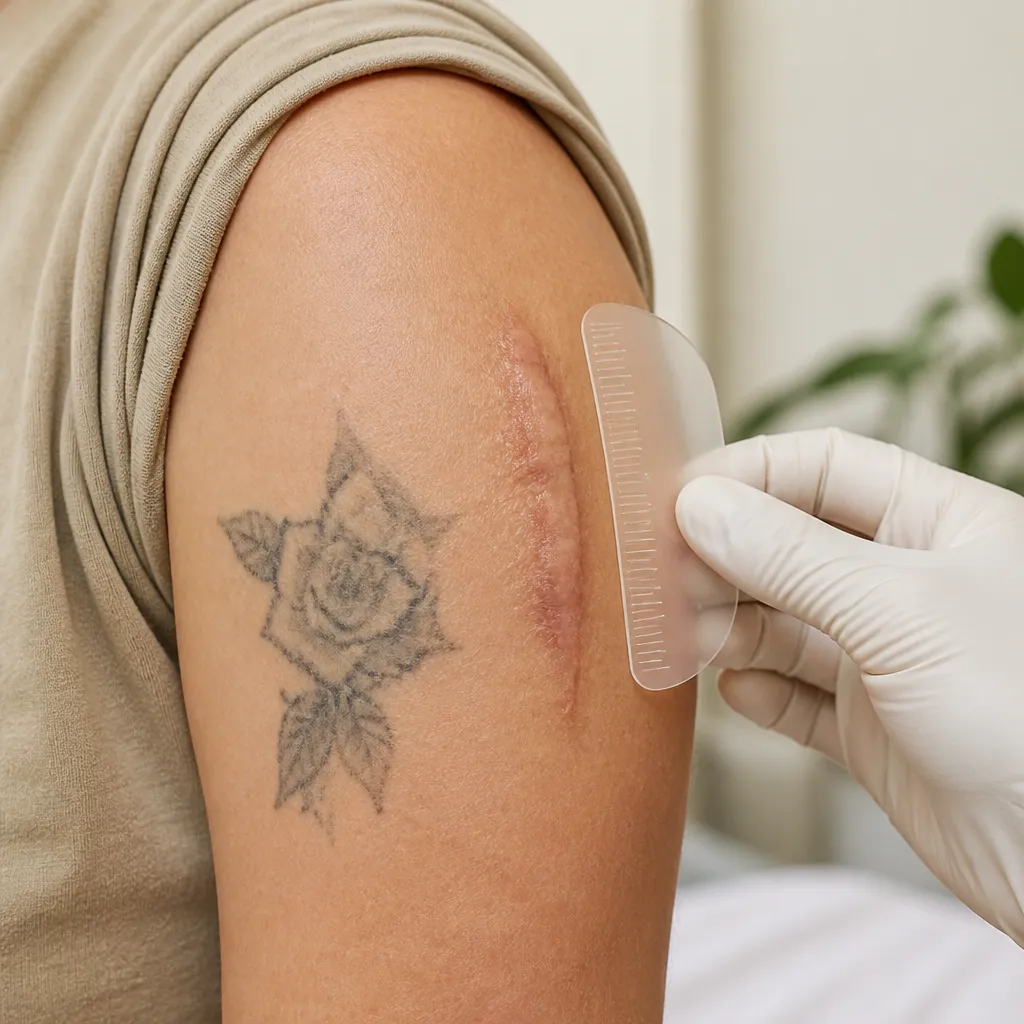
Every tattoo is a controlled injury. The needle punctures the outer layer of skin and deposits ink into the dermis, and the body responds by laying down new collagen to close the wound. In most people this repair is flat and almost invisible, but not always.
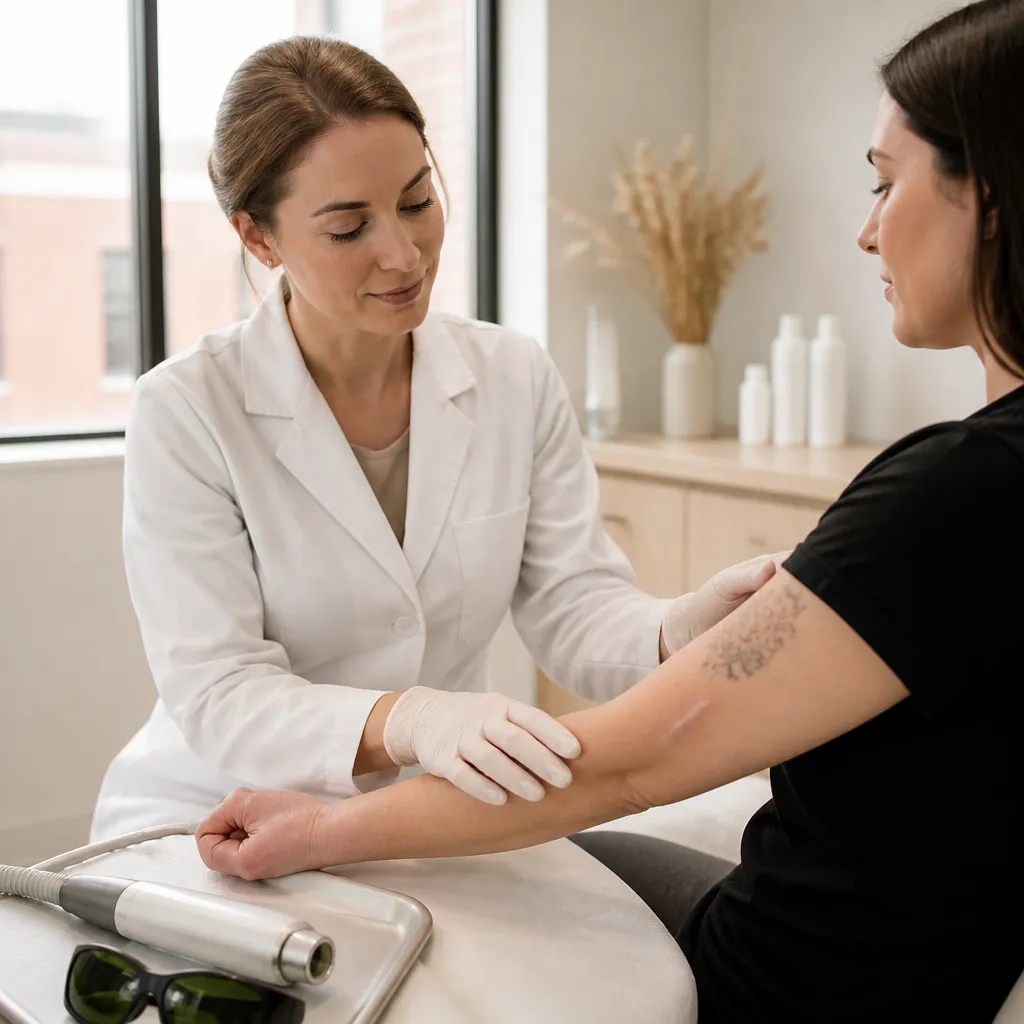
In practice, I see three patterns: flat healed skin, thickened or raised scars, and true keloids that extend beyond the original tattoo border. The first usually removes without much fuss. The second often needs more patience. The third calls for caution and sometimes a dermatologist’s opinion before anyone fires a laser at it.
Why Tattooing Itself Can Scar
Scarring is more likely when the needle goes deeper than intended, when an artist works the same area repeatedly, or when the skin was already traumatised. Cover-ups are a common cause because the skin has been worked over twice. Earlier injuries from piercings, burns or failed tattoo attempts can produce the same effect.
A client may not remember exactly what happened in the chair years ago. If you have a patchy, shiny or ridged area inside an old piece, mention it. Your consultation will be far more useful for it.
Keloids and Raised Scars
A University of Utah Health article lists keloid formation, meaning excessive scar tissue, as a possible reaction to tattooing, particularly in people predisposed to keloids. That qualifier matters. Keloids grow beyond the wound edge and do not settle on their own. If you have a family history of keloids or have scarred heavily after cuts or piercings, tell the clinic before anything else.
Pro tip: Photograph the area in daylight every two weeks for a month before your consultation. Changes in raised texture or colour are much easier to describe with pictures than from memory.
Can Laser Removal Work on Scarred Skin?
In most cases, yes, but scar tissue changes the plan. Laser energy works by targeting pigment particles, and those particles sit differently inside a scar than they do in healthy dermis. The result is usually slower clearance and a patchier outcome, which is why a scarred tattoo often needs more sessions than a comparable tattoo on clear skin.
The first job is deciding whether the scar is stable enough to treat at all. A flat, pale scar that has been healed for a long time is a different proposition from a thick, pink ridge that appeared six months ago. We treat the first group with confidence and the second with a delay or reduced settings.
How Pigment Behaves Inside a Scar
Scar tissue is denser collagen and has a different blood supply from normal skin. In practice, that means ink tends to clear more slowly and unevenly inside it, and you may see colour fade in layers rather than all at once.
A Baylor College of Medicine blog post on semi-permanent brow tattoos makes a related point from the other direction. It explains that when pigment is implanted too deep or the skin scars, laser can break up the pigment and stimulate exfoliation to push colour out of the skin. That mechanism is the one we rely on, but it works best when the scar is calm and the skin is not still healing.
Settings, Spacing and Patch Testing
Settings matter more on scarred skin. Too much energy can cause blistering, a white or dark mark, or a new scar. Too little and you pay for sessions that barely move the ink. A test area on the scar, reviewed after healing, often tells us more than any description a client can give.
Sessions are usually spaced several weeks apart so the skin can recover and the body can clear broken pigment. Rushing this stage is the most common reason people end up with more damage than they started with. If a provider offers back-to-back sessions on a scar, ask why.
Pro tip: Ask for a patch test on the scar itself, not on clear skin nearby. Healing differs from one texture to another, so the test should match the area you actually want treated.
Allergic Reactions That Mimic Scarring
Not every raised, thickened or itchy tattoo is scar tissue. Some are allergic or inflammatory reactions that look similar at first glance, and treating them as scars can make things worse. Getting that difference right is one of the most useful things a consultation can do.
Jamie Schlarbaum, MD, a dermatologist at University of Utah Health, is quoted in a May 2025 article saying that most data suggest around 1 in 1,000 individuals might have a true allergy to a component of their tattoos. Allergic skin reactions are more common, the article notes, partly because the US Food and Drug Administration does not regulate tattoo pigments. Many pigments contain metals or other additives that can trigger skin reactions.
Red Ink and Mercury Sulfide
Red ink is the one I ask about every time. The Utah article notes that red ink, which frequently contains mercury sulfide, is one of the most common culprits behind tattoo-related allergic reactions. Red and yellow pigments can also cause photosensitivity, so a sun-exposed red tattoo may flare up.
If your tattoo has red in it, tell us before the first session. We will want to know whether the red area is raised or itchy, when it last flared and whether anyone has prescribed a steroid cream for it. Those details shape both the safety plan and the choice of settings.
“A tattoo should be flat, flush with the skin, and not itchy. If a tattooed area becomes raised, inflamed, or starts itching persistently, it may indicate an allergic reaction that requires medical attention.”
Reactions That Appear Years Later
The Utah article also describes delayed hypersensitivity, where the body develops a reaction to tattoo pigment years after the tattoo was done. That is why a tattoo that sat quietly for a decade can suddenly swell. It is also why we ask about recent changes, not only how the tattoo looked on the day it was done.
Granulomas, which are small raised bumps forming around pigment, and pseudolymphomatous reactions, which are firm swollen nodules, can look a lot like scar tissue to the untrained eye. Some need steroid injections or immunosuppressive treatment, and that decision belongs to a doctor. If an area is hot, weeping or spreading, see a GP before booking any treatment.
Pro tip: Check the tattooed area in daylight for a week before booking. A flat, smooth tattoo that suddenly raises or itches is a reason to pause, not to push ahead.
Pigmentation Changes and Skin Tone Risks
Many Liverpool clients come to us for pigmentation removal as well as tattoo removal, and scar tissue complicates both. Treatment can leave lighter or darker marks, and the risk depends on your skin tone, the depth of the ink and how the skin behaves afterwards. Scars make these changes harder to predict.
The Baylor College of Medicine blog post notes that pigment does not always heal the colour the artist intended, and that skin type affects how pigment disperses. Brown pigments can heal ashy, bluish or reddish in some cases. The same principle applies to removal, where a shift in pigment can show up as a faint new colour on a scar.
Hypopigmentation After Treatment
Hypopigmentation, meaning a pale patch where pigment has been lightened too far, is a real risk on scarred skin. It is more visible on darker skin and can be harder to correct than the original tattoo. Good practice means conservative energy, a clear treatment history and a plan for a slower session if the skin reacts poorly.
We would rather clear a tattoo over more sessions than rush and leave a light patch that becomes the new feature. Tell us about any history of pale patches or keloids before we choose settings. Clients with darker skin tones should raise this at the very start of the consultation.
Sun Exposure and Tanning Before Sessions
Sun exposure before and after treatment raises the chance of pigment changes. Tanned surrounding skin contains more melanin, and the laser can be absorbed by that melanin in place of the tattoo. The rule we give most clients is simple: cover the area, avoid sunbeds and use a broad-spectrum sunscreen on the treatment zone.
Photosensitivity is a separate issue. If you take medication that increases sun sensitivity, or your tattoo contains yellow or red pigments, check with your prescriber before your session. Some reactions are triggered by sunlight alone, and a sun-exposed scar can flare more readily than clear skin.
What a Proper Scar Consultation Checks
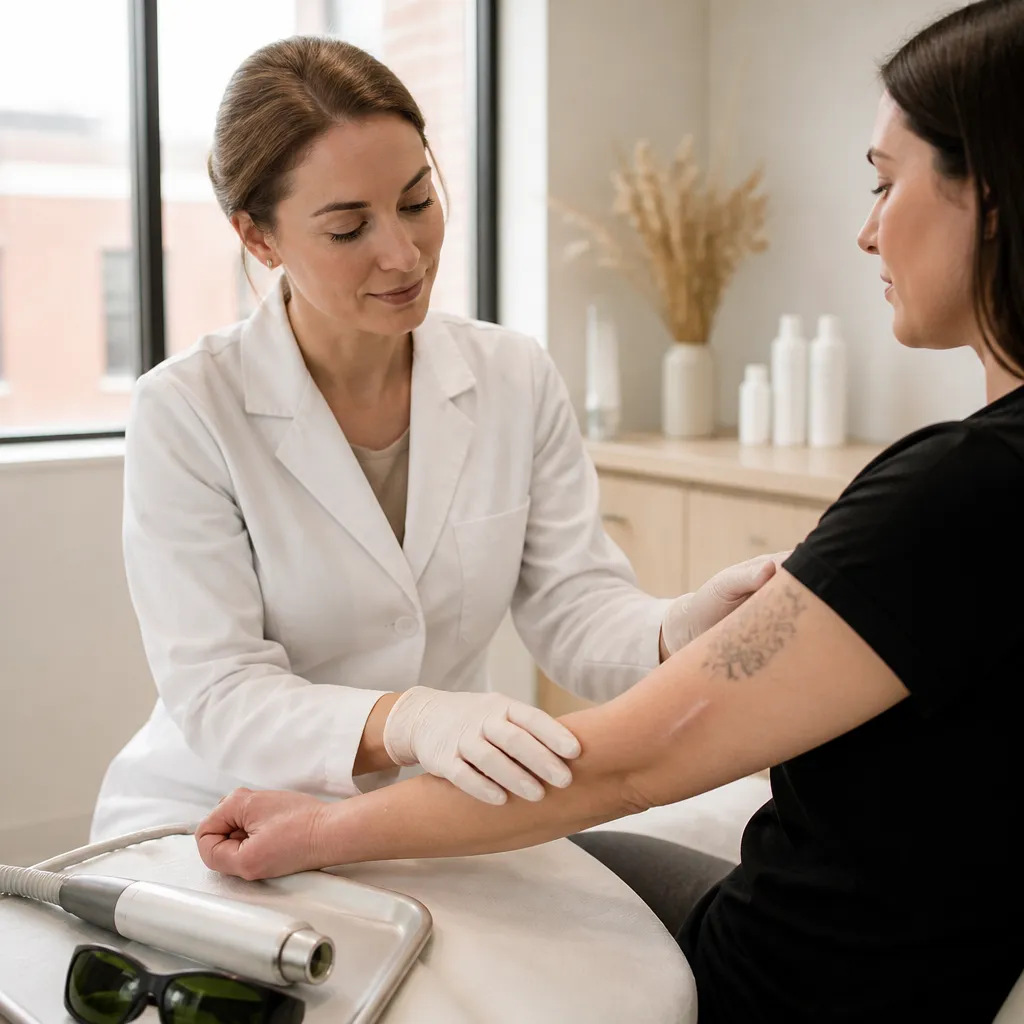
A good consultation takes longer than a quick look at the ink. At Faith Laser we start with the scar, the skin around it and your medical history, and only then talk about the pigment. If a provider quotes a price per tattoo without looking at texture, colour and healing, they are guessing.
You are entitled to ask questions and expect straight answers. The goal is a plan that fits your skin, not the fastest sale. Our Liverpool tattoo removal team will explain what we can and cannot treat before anything is booked.
Questions Your Practitioner Should Ask
Expect questions about keloids, previous burns, cosmetic procedures, autoimmune conditions, medications and recent sun exposure. Expect questions about the tattoo itself: when it was done, how many times it was covered or reworked and whether it has ever flared. These answers decide whether you are a suitable candidate and how many sessions to plan for.
Expect the practitioner to examine the area in both normal and angled light. Raised scars and bumps often show up better from a low angle. If nobody looks closely, the plan is built on guesswork.
When to Delay Treatment
Delay treatment if the scar is still red, warm, swollen or itchy. Delay it if there is an infection, a fresh cut or any broken skin on the tattoo. Delay it if you have recently been diagnosed with a skin condition that a doctor has not yet reviewed.
A delay is not a failure. Waiting for a scar to mature often makes the eventual treatment far more predictable. The clients who push ahead on inflamed skin are the ones who return with blistering and worse results.
Pro tip: Bring a written list of previous tattoos, cover-ups, piercings and injuries with approximate dates, even if they seem unrelated. Scar patterns often trace back to an old injury that nobody thought to mention.
Comparing Removal Approaches for Scarred Tattoos
There is no single right method for every scarred tattoo. The right choice depends on scar texture, pigment colour, skin tone and how much scarring you can accept at the end. The sections below compare the approaches that come up most often in consultations.
Laser Options on Scarred Ink
Q-switched lasers remain the workhorse for many tattoos, particularly black and dark blue ink on stable skin. Picosecond systems are often considered when pigment has stalled under standard settings or when a tattoo contains several colours. Neither is a guaranteed fix for thick scar tissue, and both need the same careful assessment of the skin first.
| Approach | Best suited for | Main drawback |
|---|---|---|
| Q-switched laser | Flat or slightly raised ink on stable skin, especially black and dark blue pigments | Usually needs several sessions and clears more slowly inside thicker scar tissue |
| Picosecond laser | Stubborn pigment and multicoloured tattoos where standard settings have stopped making progress | Not always necessary, and availability and approach vary from clinic to clinic |
| Surgical excision | Small, well-defined tattoos where a neat line scar is an acceptable trade | Creates a new scar and is not practical for large or raised tattoos |
When Excision Makes Sense
Surgical excision is the option I would reach for only when the tattoo is small and the resulting scar would sit along a natural line. It removes the pigment mechanically, which avoids the uncertainty of laser clearance on scar tissue. The cost is a new scar, and that is a poor trade for anyone with a history of keloids.
For larger or raised tattoos, excision is rarely the right answer. Laser remains the main route for most clients, provided the scar has settled and the settings match the skin you have.
Aftercare for Treated Scar Tissue
Aftercare on a treated scar is different from aftercare on clear skin. The area can flake, weep or feel tight for longer, and the scar may look worse for a few days before it settles. Clients who expect a clean result overnight often panic and start scrubbing, which is the wrong response.
The Baylor College of Medicine blog explains that laser can break up pigment and stimulate exfoliation to push colour out of the skin. In practice, that process shows up as flaking and scabbing, and it is part of the mechanism rather than a sign of failure. Your job is to protect the skin while it does that work.
The First Two Weeks
Keep the area clean and dry, apply the aftercare product your clinic provides and avoid picking at scabs. Do not use fragranced creams or exfoliating acids on the area until the skin has fully closed. A cold pack can ease swelling on the first day, but never place ice directly on broken skin.
Watch for signs that need medical help: spreading redness, pus, a hot area that gets worse rather than better, or a fever. Those are infection signs, and they need a GP or urgent care, not another laser session.
Sun, Heat and Scratching
Heat makes itching and inflammation worse, so skip hot baths, saunas and intense exercise for the first few days. Keep the area covered from direct sun, and use a fragrance-free sunscreen once the skin has closed. Scratching is one of the most common causes of a patchy final result, because it adds fresh trauma to a scar that is already under stress.
Pro tip: Write down the date of each session and photograph the area at the same time of day. Scar changes are slow, and a dated photo log is the quickest way to tell whether the skin is improving.
Frequently Asked Questions
Can scar tissue stop laser tattoo removal from working?
Scar tissue rarely stops removal completely, but it can slow it down and make the final result less even. Thick or raised scars usually need more sessions and more cautious settings. A consultation will show whether the scar is stable enough to treat.
Is laser tattoo removal safe on keloids?
Keloid-prone skin needs a careful plan, because laser energy can provoke new scarring in some people. Disclose any keloid history before your first session. If you have an active or recently formed keloid, get a doctor’s opinion before booking.
How long should I wait before treating a scar?
Wait until the scar is fully closed, no longer red, warm or itchy, and has stopped changing shape. There is no single calendar date that suits everyone. Your practitioner should make that decision based on what they can see and feel.
Why does my tattoo itch after a removal session?
Itching is a normal part of healing, as the skin responds to broken pigment and the body clears debris. It becomes a concern if it is persistent, spreading, or accompanied by swelling, pus or fever. In those cases, contact your clinic and a GP.
Do red tattoos behave differently when removed?
Red pigments can respond differently to laser energy, and some contain ingredients linked to allergic or photosensitive reactions. Tell your practitioner which colours are present so they can choose settings and assess risk before treating.
What was your first consultation like for a scarred or raised tattoo, and did the practitioner explain the plan clearly enough to make you feel comfortable?