Complete Tattoo Removal Liverpool: What 98% Really Means
Most people walk into a tattoo removal consultation asking one question: can you actually get rid of a tattoo completely? The answer is yes, but the detail behind that yes matters enormously. Complete tattoo removal in Liverpool is now a realistic outcome for the vast majority of clients, particularly with modern picosecond laser technology and a properly planned treatment course. But when a clinic talks about a 98% success rate, you deserve to know exactly what that figure represents, what it requires from you, and why a handful of tattoos are harder to shift than others. This article lays it all out without the vague promises.
Table of Contents
- Quick Takeaways
- What the 98% Success Rate Actually Means
- Can You Fully Remove a Tattoo? The Honest Answer
- Factors That Determine Complete Clearance
- Picosecond vs Older Laser Technology
- How Many Sessions Does Complete Removal Take?
- Tattoo Removal Results in Liverpool: What to Expect
- Frequently Asked Questions
- References
Quick Takeaways
| Key Insight | Explanation |
|---|---|
| 98% success is near-complete pigment clearance, not just fading | Success in professional laser removal is measured as the percentage of pigment cleared. A 98% rate means the treated area is visually clear to the naked eye, with no meaningful ink shadow remaining. |
| Black ink is the easiest to remove | Black ink absorbs all laser wavelengths and responds best to treatment. Single-colour black tattoos on lighter skin tones regularly achieve 95% or greater clearance. |
| Ink colour is the biggest variable affecting sessions needed | Bright reds, greens, and blues require specific wavelengths and extra sessions. White ink is the most resistant of all colours and often cannot be cleared the same way black or dark ink can. |
| Picosecond lasers outperform older Q-switched systems | Modern picosecond lasers achieve greater clearance in fewer sessions with fewer side effects than older nanosecond Q-switched devices, making them the current standard for complete removal. |
| Session count depends on ink density, not just tattoo size | A compact but heavily saturated symbol may resist treatment longer than a larger, lightly inked design. Ink density is a stronger predictor of treatment burden than size alone. |
| Spacing sessions correctly is non-negotiable | Your immune system does the clearance work between sessions. Rushing the interval between treatments does not speed up results, it reduces them. Allow your body time to flush fragmented ink particles. |
| Location on the body affects clearance speed | Tattoos on the head, neck, and chest clear faster than those on hands, feet, and lower legs. Blood flow and lymphatic drainage in each area directly affect how quickly the body removes broken-down ink. |
What the 98% Success Rate Actually Means
A 98% success rate is a statement about pigment clearance, not a marketing claim. It refers to the percentage of visible ink that is eliminated after a full course of laser treatment sessions. This is not the same as 98% of all tattoos being gone after a single session, and it is not a guarantee that every tattoo on every skin type will respond identically.
The measurement that underpins this kind of figure comes from clinical assessments of photographic pigment clearance. One published study using the Frac-Tat treatment method reported an average photographic pigment clearance of 97% after a median of roughly five treatment sessions, with photographic assessment of skin quality considered almost comparable with untreated peripheral skin. That is a meaningful clinical benchmark, not an estimate.
Where figures vary between providers and studies is in how “success” is defined. Some older studies defined success as 75% fading, while newer protocols and advanced technology push that threshold to near-complete clearance. The distinction matters if you are aiming for a clean slate rather than a lighter shadow. At Faith Laser, when we reference 98% effectiveness, we mean visible, near-complete elimination of ink, not a partial fade.
Success in tattoo removal is not a binary event. It is a spectrum measured by pigment clearance percentage, and that percentage rises with each correctly spaced session. The technology you start with determines how far along that spectrum you can realistically travel.
Pro tip: When comparing clinics, always ask what their quoted success rate actually measures. A figure based on 75% pigment clearance and one based on 98% clearance are describing entirely different outcomes, even if both are called “successful removal.”
Can You Fully Remove a Tattoo? The Honest Answer
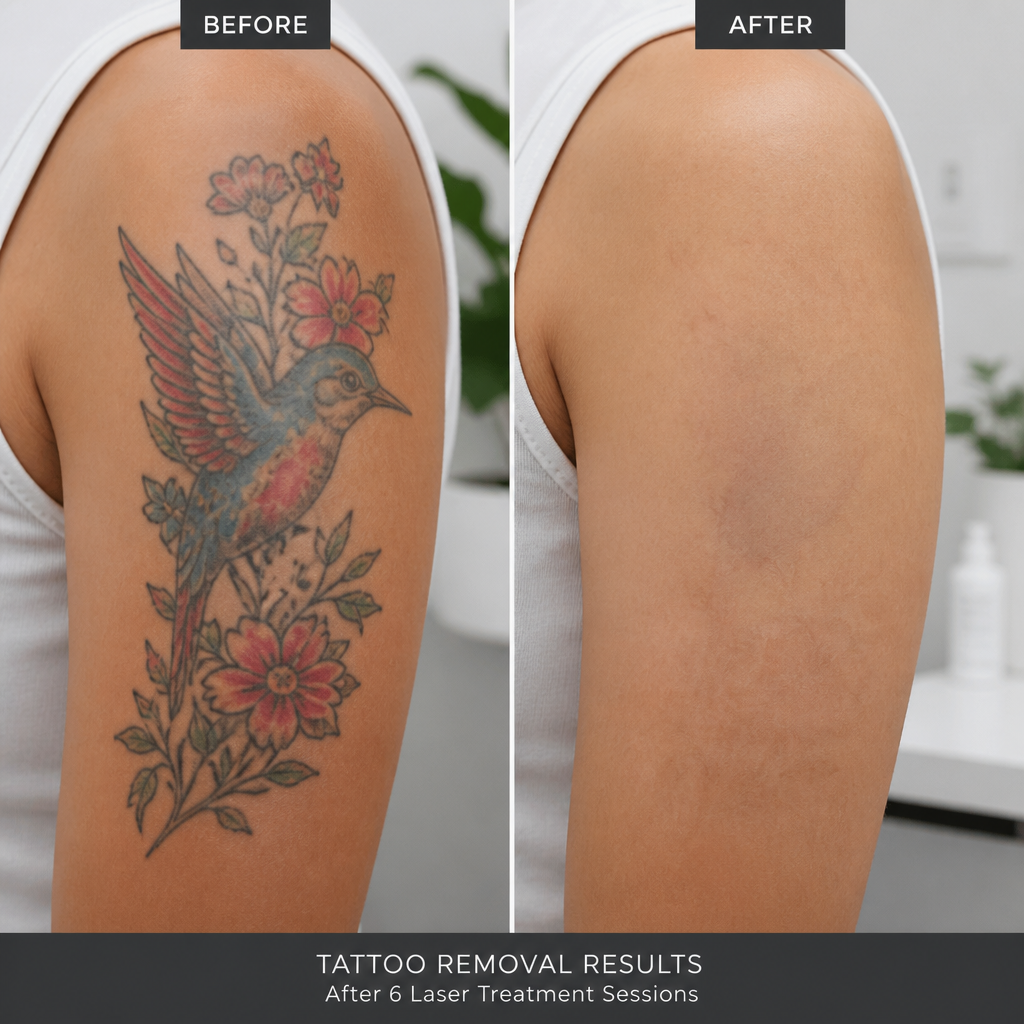
Yes, most tattoos can be fully removed. This was not always the case with earlier laser technology, but it is the reality with modern picosecond systems when used correctly across an adequate number of sessions. The honest caveat is that “fully” does not always mean zero trace. For most clients on most tattoos, the result is skin that looks clear and unmarked in everyday life. In rare cases involving very heavy ink saturation, dense layering of cover-up tattoos, or particularly resistant ink colours, a faint residual shadow may remain even after ten or more sessions.
A large retrospective cohort study found that 47.2% of patients reached therapy success after 10 laser sessions, rising to 74.8% after 15 sessions. Those figures come from older Q-switched laser studies. With current picosecond technology, clearance rates and session efficiency have both improved substantially. Picosecond lasers achieve greater clearance in fewer sessions with fewer side effects than older nanosecond devices, which directly shifts those success percentages upward for clients treated today.
When Complete Removal Is Most Achievable
Complete removal is most predictably achievable when the tattoo uses a single dark colour on a lighter skin tone, is professionally applied at consistent depth, has not been layered over a previous tattoo, and sits on a part of the body with good circulation. Amateur tattoos, counter-intuitively, often respond faster than professional ones because the ink is deposited less evenly and at shallower depths.
When You Should Adjust Your Expectations
Cover-up tattoos, tattoos with white or bright yellow ink, tattoos on the hands and feet, and tattoos on darker skin tones require more sessions and more careful laser settings. None of these situations make complete removal impossible, but they do make it a longer journey. A thorough consultation that assesses your specific tattoo, not a generic quote based on size alone, is the only way to set an accurate expectation for your result.
Factors That Determine Complete Clearance
The clinical tool most widely used to predict how many sessions a tattoo will need is the Kirby-Desai scale, which scores factors including skin type, ink colour, ink volume, layering, location on the body, and the presence of any scarring. Understanding these factors individually helps explain why two tattoos of the same size can have very different treatment journeys.
Ink Colour
Ink colour is the single most important variable in determining ease of removal. Black ink absorbs all laser wavelengths, which means it responds to treatment the most predictably and clears in the fewest sessions. Dark blue and dark green follow a similar pattern. Red, orange, and yellow require specific wavelengths to target effectively. White ink is the most resistant, and white or flesh-toned cosmetic tattoos require particular care because of the risk of paradoxical darkening, a reaction where the ink oxidises and temporarily appears darker before it can be cleared.
Skin Type
Darker skin types require more conservative laser settings to avoid disrupting the skin’s own melanin alongside the tattoo ink. This does not prevent complete removal, but it means the treatment course may involve lower energy settings, more sessions, and longer intervals between appointments to protect the skin.
Tattoo Location
Tattoos on the head, neck, and chest consistently clear faster than those on the hands, feet, and lower legs. The reason is blood flow and lymphatic drainage. The immune system is responsible for carrying away fragmented ink particles after each laser session, and areas with stronger circulation simply move that debris out of the skin more efficiently.
Ink Depth and Density
Ink density, not tattoo size, is the primary driver of how many sessions are needed. A small, heavily saturated design may require more treatment than a larger, lightly inked piece. A published predictive model study found that tattoo size did not significantly determine session count, while ink density was the major factor.
Pro tip: If you have a cover-up tattoo, bring a photograph of the original design to your consultation if you have one. Knowing what is underneath the cover-up helps a practitioner plan your session schedule far more accurately than a visual assessment alone.

Picosecond vs Older Laser Technology
The shift from Q-switched nanosecond lasers to picosecond lasers is the single biggest technological development in tattoo removal over the past decade. Understanding the difference is directly relevant to whether you can achieve complete clearance, how many sessions it will take, and what the skin looks like afterwards.
How Picosecond Lasers Work
Picosecond lasers deliver energy in pulses measured in trillionths of a second rather than billionths. This matters because tattoo ink particles have thermal relaxation times in the picosecond range. Delivering energy faster than the particle can dissipate heat creates a photomechanical shattering effect rather than a purely photothermal one. The ink is broken into smaller fragments that the immune system can clear more easily, which explains both the improved clearance rates and the reduced risk of burning and blistering on surrounding tissue.
Comparing the Two Approaches
| Feature | Picosecond Laser | Q-Switched Nanosecond Laser |
|---|---|---|
| Pulse duration | Trillionths of a second (picoseconds) | Billionths of a second (nanoseconds) |
| Ink fragmentation mechanism | Photomechanical (physical shattering) | Primarily photothermal (heat-based) |
| Sessions typically needed | Fewer: 20-30% reduction for pre-treated tattoos vs. older systems | More: typically 6-15 sessions for professional tattoos |
| Side effect profile | Lower risk of burning and blistering | Higher risk of thermal damage to surrounding skin |
| Cosmetic tattoo handling | Lower risk of paradoxical darkening | Higher risk of paradoxical darkening |
| Coloured ink clearance | Broader range of colours treated effectively | More limited, particularly for resistant colours |
Older Q-switched systems are not obsolete, and they can still achieve meaningful clearance on straightforward black tattoos. But for anyone targeting complete removal, particularly on coloured ink or previously treated tattoos, picosecond technology is the clear choice. The published comparison confirms that picosecond lasers are superior for removing cosmetic tattoos including flesh-coloured inks, and the degree of paradoxical darkening is significantly lower with picosecond technology than with Q-switched lasers.
How Many Sessions Does Complete Removal Take?
There is no single honest answer to this question that applies to every tattoo, which is precisely why any provider quoting a fixed number of sessions without a consultation is guessing. What the evidence does allow is a realistic framework for setting expectations.
For a single-colour black tattoo on a lighter skin tone treated with picosecond technology, complete or near-complete removal commonly requires somewhere between 6 and 12 sessions. Heavily saturated professional tattoos may require more. A published predictive-model study found an average of 6 sessions overall, but with a range of 2 to 20, showing just how wide individual variation can be. Multi-colour tattoos or cover-up pieces often require 10 sessions or more, depending on the density of layered ink.
The Role of Session Spacing
Session spacing is as important as session count. The immune system does the actual work of clearing fragmented ink particles between appointments. Rushing that interval does not speed up results. Most practitioners recommend a minimum of 6 to 8 weeks between sessions, and for tattoos in areas with slower circulation such as the feet or lower legs, longer gaps may improve outcomes. Arriving at each session having followed aftercare instructions, avoided sun exposure, and kept the treated area moisturised all contribute to better clearance per session.
Why Some Tattoos Need Reassessment Mid-Course
It is entirely normal to reassess a treatment plan partway through a course. Some tattoos reveal unexpected ink colours or layering once the outer layers begin to clear. A practitioner who adjusts wavelength settings or session spacing based on how your specific tattoo is responding is doing exactly the right thing, not changing the plan because something went wrong.
Tattoo Removal Results in Liverpool: What to Expect
For anyone seeking tattoo removal results in Liverpool, the most important thing to understand is that outcomes are driven by technology, practitioner skill, and the biology of your individual skin, not by geography. What matters is whether the clinic uses current-generation picosecond lasers, whether the practitioner assesses your tattoo in detail before quoting a session count, and whether the aftercare guidance is specific rather than generic.
At Faith Laser, every treatment course begins with a consultation that considers ink colour, skin type, tattoo location, and the presence of any layering. The approach is built around achieving the highest possible clearance rate on your specific tattoo, not a one-size-fits-all protocol. The 98% effectiveness figure reflects the outcomes achievable with state-of-the-art laser technology combined with a treatment plan that is genuinely tailored to each client.
Aftercare Is Part of the Result
What you do between sessions materially affects how much clearance you achieve per treatment. The fundamentals are consistent: keep the treated area out of direct sunlight, do not pick or scratch any scabbing that forms, keep the area clean and moisturised, and stay well-hydrated to support lymphatic clearance of ink particles. These are not optional extras. A client who follows aftercare carefully and spaces sessions appropriately will consistently achieve better clearance than one who does not, regardless of which laser was used.
How Faith Laser Differs from Generic Providers
Some providers offer laser tattoo removal as one of a dozen unrelated treatments with minimal specialisation in the process. Faith Laser focuses specifically on laser treatments, which means the practitioners understand the technology in depth and can adapt settings to your tattoo’s specific characteristics rather than applying a default protocol. That specialisation is the practical difference between adequate fading and genuine complete removal for clients with complex or multi-colour tattoos.
If you are considering laser hair removal alongside tattoo removal, Faith Laser’s full range of laser services means your treatment can be coordinated under one roof with consistent standards of care.
Frequently Asked Questions
Can you fully remove a tattoo or will a shadow always remain?
Most tattoos can be fully removed to the point where no shadow is visible in everyday life. Near-complete clearance, meaning 95% or more of the visible ink removed, is the realistic outcome for the majority of black and dark-coloured tattoos treated with picosecond lasers over a sufficient number of sessions. A faint residual shadow is more common with very dense multi-colour tattoos, cover-up pieces, or tattoos with resistant colours like bright green or white. Even in those cases, the result is dramatically improved compared to the original tattoo.
How many sessions will I need for complete tattoo removal in Liverpool?
The range is broadly 6 to 12 sessions for most professional black tattoos, with multi-colour or heavily layered tattoos requiring more. Published studies show an average of around 6 sessions but a range extending to 20 for complex cases. The only way to get an accurate estimate for your specific tattoo is a proper face-to-face consultation where the practitioner assesses ink colour, density, skin type, and tattoo location together.
Does the colour of the tattoo affect whether it can be completely removed?
Yes, significantly. Black ink is the most responsive to laser treatment and clears most predictably. Dark blues and greens follow closely. Reds, oranges, and yellows require specific laser wavelengths and take longer. White and flesh-toned inks are the most challenging and carry additional considerations around paradoxical darkening. The good news is that modern picosecond lasers handle a broader colour range than older systems, making complete removal achievable for colours that previously had limited treatment options.
Is laser tattoo removal painful?
Most clients describe the sensation as similar to a rubber band snapping against the skin, which is uncomfortable but tolerable. The level of discomfort varies depending on the tattoo’s location, the laser energy used, and individual sensitivity. Areas close to bone or with thinner skin tend to be more sensitive. Topical numbing cream can be applied before the session to reduce discomfort, and practitioners will adjust the approach based on your feedback throughout the treatment.
What makes Faith Laser different for complete tattoo removal in Liverpool?
Faith Laser uses state-of-the-art laser technology specifically focused on achieving complete clearance rather than basic fading. The 98% effectiveness rate reflects a combination of current-generation laser equipment, individually tailored treatment planning, and detailed aftercare guidance. Rather than offering laser treatment as an add-on service, tattoo and hair removal are the clinic’s dedicated specialisms, which means both the equipment and the practitioner expertise are focused entirely on laser outcomes.
How long should I wait between tattoo removal sessions?
A minimum of 6 to 8 weeks between sessions is standard practice. This interval exists because the immune system needs time to flush out the ink particles fragmented by the laser. Shortening this gap does not speed up the overall removal, it reduces clearance per session because the body has not had time to finish processing the previous treatment. For tattoos on slower-clearing areas like the lower legs or feet, even longer intervals may improve your final result.
Can a cover-up tattoo still be fully removed?
Yes, but cover-up tattoos are among the more demanding cases in laser removal. They typically involve higher ink density, multiple colours from both the original and cover-up designs, and ink deposited at varying depths. Complete removal is achievable but usually requires more sessions than a single-layer tattoo of comparable size. A thorough consultation is especially important for cover-up pieces, as the treatment plan needs to account for what is layered underneath the visible design.
Have you already started a tattoo removal course, or are you weighing up whether to go ahead? Share your experience or questions below. We read every message and your question may help someone else in exactly the same position.
References
- Published clinical study reporting 97% average pigment clearance using the Frac-Tat laser method after a median of approximately five treatment sessions
- Overview of tattoo removal success rates including cohort data on clearance percentages after 10 and 15 laser sessions
- Analysis of picosecond laser technology versus older nanosecond systems and the reduction in sessions and side effects
- Peer-reviewed comparison of picosecond versus Q-switched nanosecond Nd:YAG lasers for tattoo removal, including paradoxical darkening outcomes
- Clinical review of laser tattoo removal outcomes including session counts, pigment clearance expectations, and optimising patient results