How Does Laser Hair Removal Work? The Real Science
You shave on Monday, and by Wednesday you are already reaching for the razor again. Waxing hurts, threading is time-consuming, and every method you have tried feels like a temporary fix to a permanent problem. So when people in Liverpool start researching laser hair removal, the first question they inevitably land on is: how does laser hair removal work, and is the science actually solid enough to trust? The short answer is yes – the mechanism behind it is well-established, precise, and genuinely different from anything you have tried at home. This article breaks down the laser hair removal science from first principles, so you can walk into a consultation at Faith Laser knowing exactly what will happen to your skin and why.
Table of Contents
- The Core Science: Selective Photothermolysis
- The Role of Melanin: Why Hair Colour Matters
- Hair Growth Cycles and Why You Need Multiple Sessions
- Types of Lasers Used and How They Differ
- What Actually Happens During a Session
- Side Effects and Safety: What the Evidence Shows
- Laser Hair Removal vs. Other Methods
- Frequently Asked Questions
- References
The Core Science: Selective Photothermolysis
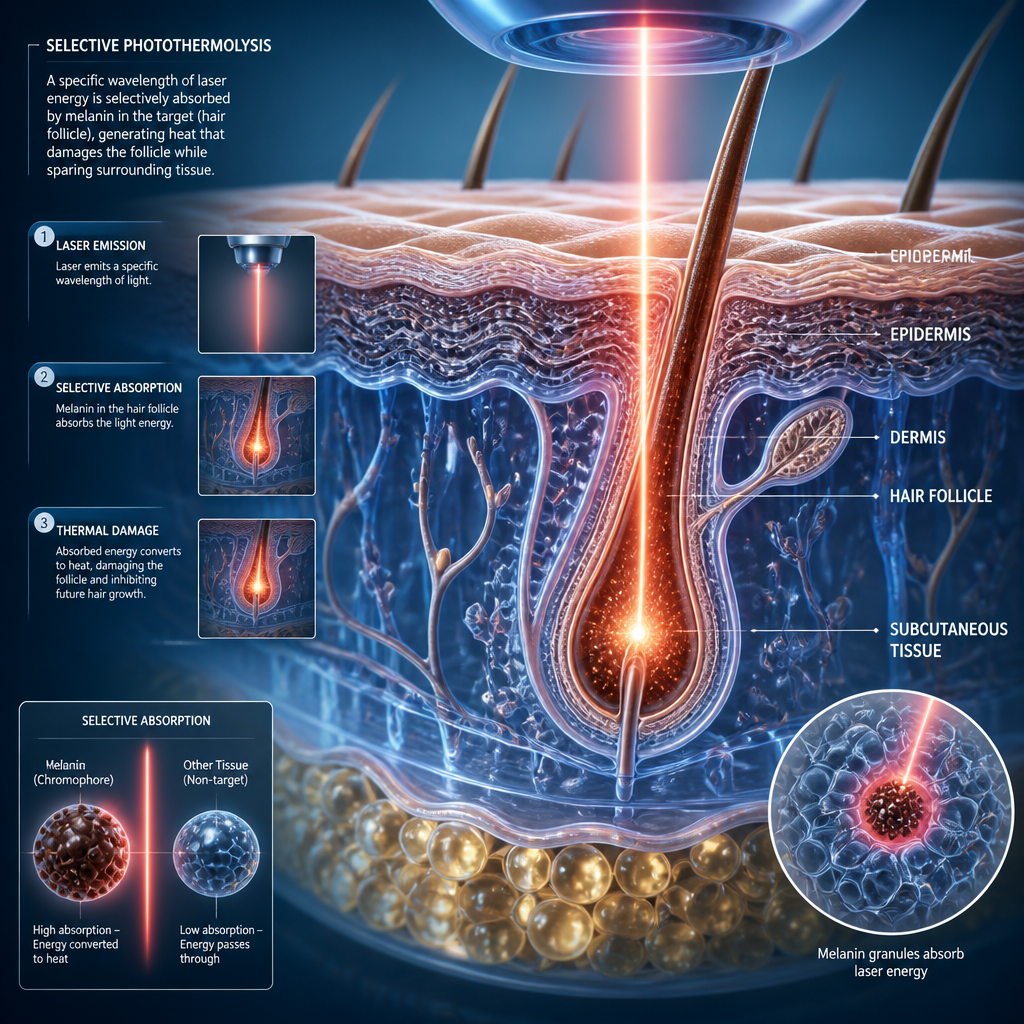
The entire mechanism of laser hair removal rests on a single scientific principle called selective photothermolysis. Break the word down and it tells you everything: photo (light), thermo (heat), lysis (destruction). The laser delivers concentrated light energy that is selectively absorbed by a specific target, in this case the pigment inside your hair follicle, converting that light into heat and destroying the follicle without significantly damaging the surrounding skin tissue.
The “selective” part is what separates professional laser treatment from simply shining a hot light at your skin. The laser’s wavelength is precisely calibrated so that melanin, the dark pigment that gives hair its colour, absorbs the energy far more readily than the surrounding skin cells do. When the pulse fires, heat builds rapidly inside the follicle. The goal is to raise the temperature high enough to damage the follicle’s ability to produce new hair, while keeping the surrounding tissue cool enough to recover unharmed.
Pro tip: Selective photothermolysis is not a marketing term – it is the published, peer-reviewed basis for all clinical laser hair removal. When a clinic cannot explain this principle clearly, that tells you something about the quality of their training.
This precision is also why laser treatment at a professional clinic like Faith Laser produces results that home devices simply cannot replicate. Professional equipment is calibrated to clinical energy levels; consumer devices are capped well below the thresholds needed for meaningful follicle damage.
The Role of Melanin: Why Hair Colour Matters
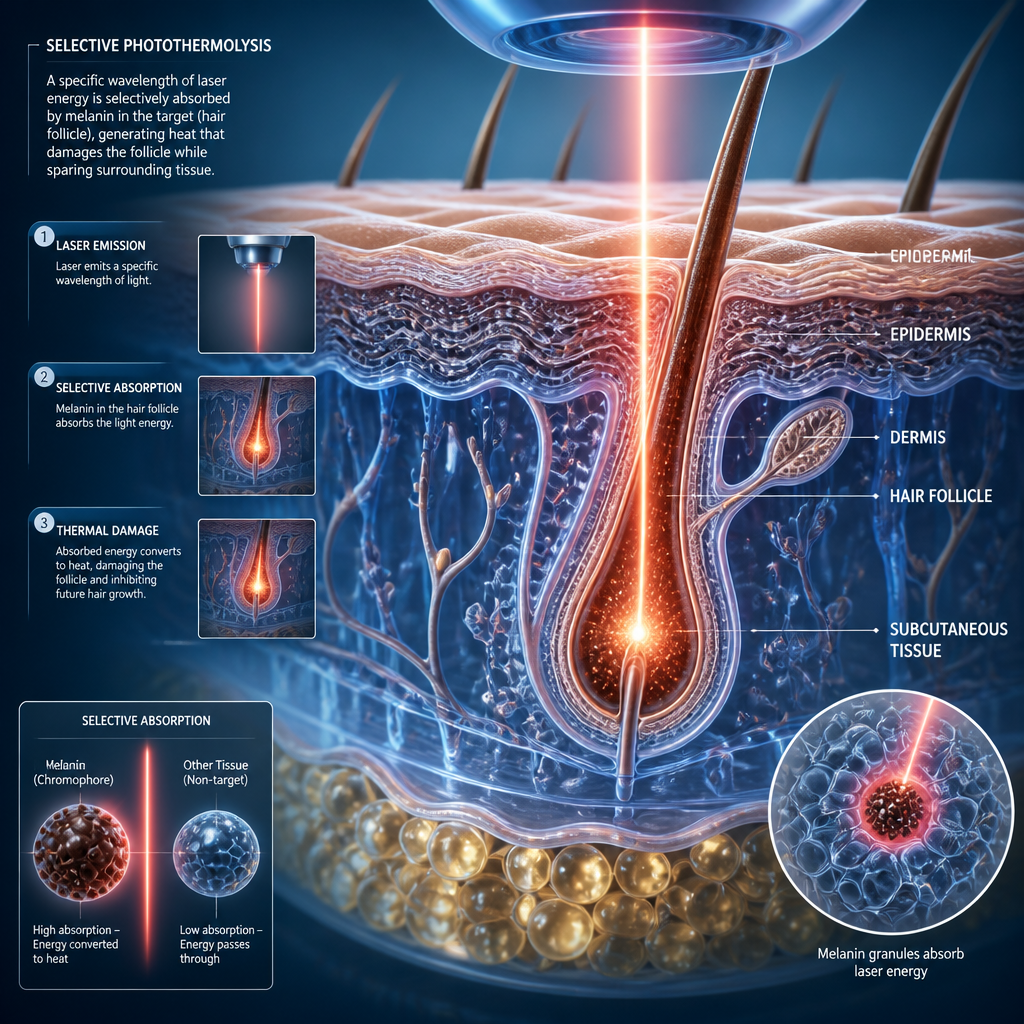
Melanin is the chromophore, the light-absorbing molecule, that makes laser hair removal possible. The chromophore in laser hair removal is melanin, which absorbs light across a broad spectrum, and it is concentrated far more heavily in the hair shaft and the hair matrix cells than in the surrounding follicle wall. That concentration gradient is exactly what the laser exploits.
This is also why hair colour has historically mattered so much. Dark hair contains more melanin, which means it absorbs more laser energy and generates more heat inside the follicle. Light blonde, grey, or white hair contains very little melanin, which means the laser has far less to target. In practice, the ideal candidate for laser hair removal has always been someone with dark hair. People with very light or unpigmented hair remain difficult to treat with current laser technology, regardless of skin tone.
The laser’s wavelength is carefully calibrated so that melanin absorbs the energy while the surrounding skin tissue remains largely unaffected – this precision is what makes the treatment both effective and safe when performed correctly.
Skin tone is the other half of this equation. Darker skin tones also contain more melanin in the epidermis, which creates a competing target for the laser energy. Early laser systems struggled with this, producing inconsistent results and a higher risk of surface burns on darker skin. Modern platforms, including Nd:YAG and diode lasers, have significantly widened the range of skin tones that can be treated safely and effectively, which is why a proper consultation and skin assessment before any course of treatment is non-negotiable.
Hair Growth Cycles and Why You Need Multiple Sessions
One of the most common sources of confusion about laser hair removal is why a single session is never enough. The reason is biological, not commercial. Your hair follicles do not all grow at the same time. They cycle through four distinct phases, and the laser is only effective during one of them.
The Four Phases of Hair Growth
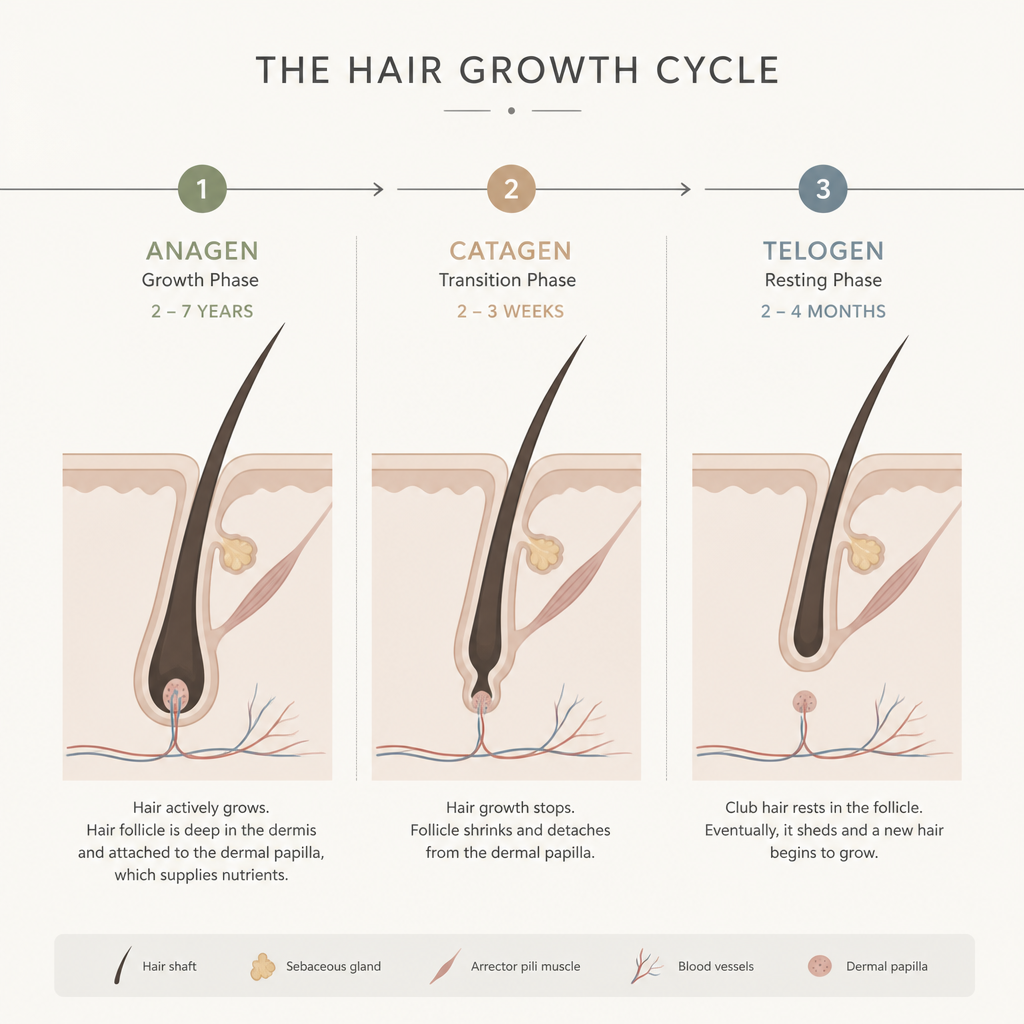
The anagen phase is the active growth stage. During anagen, the hair is firmly rooted in the follicle, the connection between shaft and papilla is intact, and melanin concentration is at its highest. This is the only phase in which laser energy can travel down the hair shaft and effectively heat the follicle enough to damage it. The catagen phase is a brief transitional stage where the hair detaches from the follicle wall and growth slows, making it far less responsive to laser treatment. The telogen phase is the resting stage, when the follicle is dormant and largely unresponsive to laser energy. The exogen phase is when old hairs shed, clearing the way for new anagen growth to begin.
At any given moment, only a proportion of your follicles are in the anagen phase. A single session can only target those active follicles, which is why most people need multiple sessions spaced over time to catch each follicle as it cycles back into its growth phase. Most people need somewhere between five and ten sessions to achieve comprehensive, lasting hair reduction across a treated area.
Pro tip: Do not shave immediately before a session expecting to speed things up, but do shave two to three days beforehand as instructed. The hair needs to be short enough for the laser to work efficiently, but the follicle and its melanin must still be present beneath the skin surface.
Types of Lasers Used and How They Differ
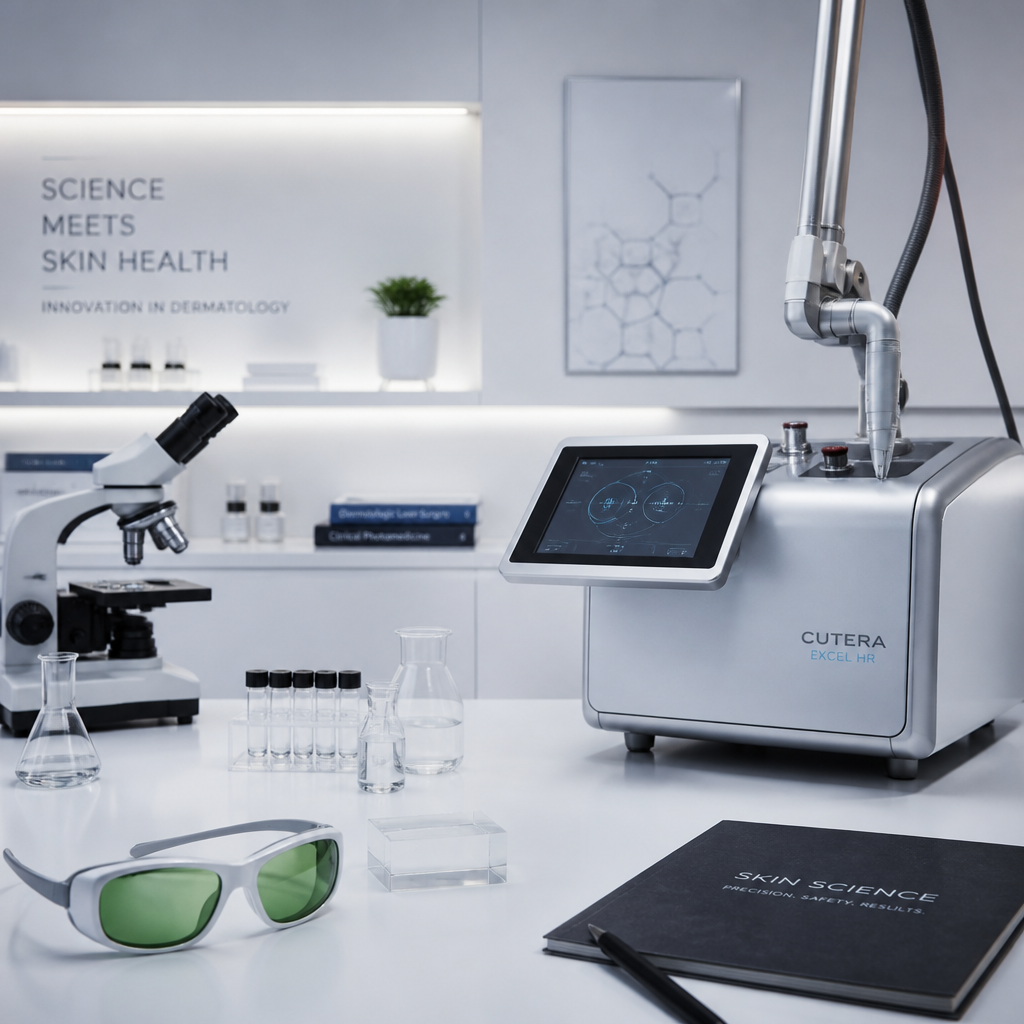
Not all laser hair removal systems are the same, and the differences between them matter depending on your skin tone and hair type. The lasers currently used clinically for hair removal include the alexandrite, diode, and Nd:YAG systems, each operating at a different wavelength and with different optimal use cases.
Choosing the right laser for your skin type is one of the most important decisions in the entire treatment process. Using the wrong system on the wrong skin tone increases the risk of surface burns, hyperpigmentation, or poor results – all of which are avoidable with proper clinical assessment.
Laser Type Comparison
| Laser Type | Best Suited For | Key Characteristic |
|---|---|---|
| Alexandrite (755 nm) | Fair to light skin tones (Fitzpatrick I-III), dark coarse hair | High melanin absorption, fast treatment speed for larger areas; not suitable for darker skin tones |
| Diode (808 nm) | Light to medium-dark skin tones (Fitzpatrick I-IV), wide range of hair types | Deeper tissue penetration than alexandrite; effective across a broader skin tone range |
| Nd:YAG (1064 nm) | Darker skin tones (Fitzpatrick IV-VI), tanned skin, coarse hair | Longest wavelength; bypasses surface melanin to reach follicle safely in darker skin; protects epidermal pigment |
A published comparison of these systems found that alexandrite and diode lasers delivered comparable efficacy results when treatment sessions were accounted for, and both outperformed Nd:YAG in terms of raw hair reduction percentages – though Nd:YAG remains the safest and most appropriate choice for clients with darker skin tones where other systems carry higher risk. The right answer depends entirely on your individual skin and hair profile, which is why a thorough consultation matters before committing to a course.
What Actually Happens During a Session
Knowing the theory is useful, but understanding the practical sequence of a session removes the anxiety that puts many people off booking. At Faith Laser in Liverpool, the process is structured and methodical, not rushed.
Before the Laser Fires
The treatment area is cleaned and prepared. Many clinics apply a cooling gel or use a built-in contact cooling system on the handpiece to protect the surface of the skin during the pulse. You will be given protective eyewear, and so will the clinician. If needed, a topical anaesthetic can be applied beforehand for more sensitive areas such as the upper lip or bikini line.
During the Treatment
The clinician moves the laser handpiece across the treatment area, delivering pulses of concentrated light energy to the skin. Each pulse lasts a fraction of a second and treats a small patch of follicles simultaneously. Most people describe the sensation as similar to a brief snap of a warm elastic band against the skin. Larger areas such as the legs take longer than smaller zones like the underarms. The procedure involves no incisions and no downtime.
After the Session
Immediately after treatment, it is common to see some redness and mild swelling in the treated area. This is a normal inflammatory response to the heat and typically resolves within a few hours. Treated hairs do not fall out instantly. Over the following one to three weeks, the damaged follicles shed the treated hairs. The skin in between sessions should be protected from sun exposure, and waxing or plucking must be avoided, as these disrupt the follicle between sessions and undermine results.
Side Effects and Safety: What the Evidence Shows
Laser hair removal has a well-documented safety profile when performed correctly on appropriate candidates by trained practitioners. The most common side effects, redness and mild swelling, occur after most treatments but are temporary and minor. The sensation has been described as similar to a very mild sunburn, and for the vast majority of clients any discomfort resolves within hours.
Less common side effects include temporary pigmentation changes. People with lighter skin may see some temporary darkening of treated areas, while people with darker skin may notice temporary lightening. Both effects are generally short-lived. Rarer risks include blistering, scarring, or significant pigmentation changes, and these are almost always linked either to treatment on recently tanned skin or to incorrect laser settings for the client’s skin type – precisely the scenarios that a rigorous pre-treatment consultation is designed to catch and prevent.
The conditions that make laser hair removal unsuitable or require extra caution include active tanning or sunburn, certain medications (some acne treatments in particular can increase photosensitivity), a history of keloid scarring, and pregnancy, where caution is advised due to the absence of safety data from human studies.
One important distinction to be clear on: laser hair removal produces long-lasting, significant hair reduction, but it is more accurate to describe it as long-term hair reduction rather than absolute permanent removal. Some follicles may eventually regenerate activity, and maintenance sessions may be needed over time. Any any clinic or advert claiming guaranteed permanent removal in a handful of sessions is overstating what the science supports.
Laser Hair Removal vs. Other Methods
Placing laser treatment in context against the alternatives helps clarify why more people in Liverpool are choosing it over the methods they have relied on for years. The comparison is not just about comfort. It is about cumulative cost, cumulative time, and cumulative results.
| Method | Duration of Results | Key Limitation |
|---|---|---|
| Shaving | 1-3 days | Requires constant repetition; causes regrowth irritation; no follicle damage |
| Waxing / Threading | 3-6 weeks | Painful; repeated treatments over years; temporarily disrupts follicle but does not destroy it |
| Laser Hair Removal | Months to years per treated follicle, with significant long-term reduction | Requires multiple sessions; not effective on very light or grey hair; requires professional administration |
Waxing and threading were practical answers to unwanted hair before laser technology existed, but they are associated with significant pain and prolonged treatment times, particularly for larger areas of the body. Laser hair removal was first introduced in the mid-1990s and has since become an established clinical modality that has been shown to improve quality of life for many patients who previously relied on these temporary methods.
The case for laser treatment is strongest when you look at the long run. The upfront investment in a course of sessions at a Liverpool clinic like Faith Laser typically replaces years of recurring waxing costs and the consistent time expenditure of daily or weekly shaving. For areas like underarms, legs, or intimate zones, the arithmetic becomes compelling within a couple of years.
Pro tip: If you are comparing clinics in Liverpool, ask specifically what laser system they use and why it suits your skin type. A clinic that cannot answer that question clearly, or that offers a one-size-fits-all approach regardless of Fitzpatrick skin type, is not applying the science correctly.
Frequently Asked Questions
Does laser hair removal hurt?
Most people describe the sensation as a brief, warm snap, similar to a small elastic band flicking against the skin. It is significantly less painful than waxing for most clients. Sensitive areas such as the upper lip or bikini line tend to be more uncomfortable, and a topical anaesthetic can be applied beforehand for those zones if needed. Modern laser handpieces also incorporate cooling systems that reduce surface discomfort considerably.
How many sessions will I need?
Most people need between six and eight sessions to achieve substantial, long-lasting hair reduction, though the total varies depending on the treatment area, hair thickness, hair colour, and hormonal factors. Sessions are typically spaced four to eight weeks apart to allow the hair growth cycle to advance and bring new follicles into the targetable anagen phase. Hormonal conditions such as polycystic ovary syndrome can require additional sessions to manage ongoing follicular stimulation.
Is laser hair removal safe for dark skin tones?
Yes, when the correct laser is used. The Nd:YAG laser at 1064 nm has a longer wavelength that passes through surface skin melanin to target the deeper follicle, making it the appropriate clinical choice for clients with darker skin tones. The risk arises when the wrong laser system is used for a given skin type, which is why skin assessment before treatment is not optional, it is fundamental to safe practice.
Can laser hair removal be used on any part of the body?
Laser hair removal can be used on most areas of the body including underarms, legs, the bikini line and intimate zones, the back, chest, and face. The one consistent restriction is the area immediately around the eyes, where protective eyewear must be worn. At Faith Laser, treatments are available across a broad range of body areas including facial zones, underarms, and intimate areas, with settings adjusted for the specific characteristics of each location.
Why is laser hair removal more effective than IPL?
IPL, or Intense Pulsed Light, uses a broad spectrum of light wavelengths rather than a single, precise wavelength. A laser delivers monochromatic light that is tuned specifically to the absorption peak of melanin, which means the energy is more efficiently directed at the follicle. IPL scatters energy across a wider range of wavelengths, making it less precise and generally less effective per session than clinical laser systems. IPL can still deliver results, but it typically requires more sessions and is not suitable for as wide a range of skin tones as professional laser technology.
What should I avoid before and after a laser session?
Before treatment, avoid sun exposure and tanning beds for several weeks, as tanned skin increases the risk of side effects. Shave the area two to three days before your appointment, but do not wax or pluck, as the follicle must be intact for the laser to target. After treatment, continue to avoid sun exposure, apply SPF diligently, and do not wax or thread between sessions. Keep the area clean and moisturised, and contact your clinic if you notice anything beyond normal redness and mild swelling.
Have you had laser hair removal, or are you still weighing it up against other methods? We would love to hear what questions you still have or what your experience has been like so far.
References
- American Society for Laser Medicine and Surgery: clinical overview of laser hair removal and selective photothermolysis
- Cleveland Clinic: laser hair removal treatment guide including safety, procedure, and what to expect
- National Institutes of Health, National Library of Medicine: peer-reviewed overview of laser hair reduction science and chromophore theory
- Milan Laser: explanation of the hair growth cycle phases and why multiple laser sessions are required
- Journal of the American Academy of Dermatology: comparative study of alexandrite, diode, and Nd:YAG laser efficacy for hair removal