Most people walking into their first laser hair removal appointment are underprepared in at least one specific way. They shaved too early, forgot to ditch the fake tan, or slathered on body lotion that morning without thinking. Any one of those mistakes can force a rebooking or, worse, lead to a disappointing result from an otherwise effective treatment. Good laser hair removal preparation is not complicated, but it is precise, and the difference between a smooth session and a wasted appointment often comes down to decisions made days or weeks beforehand. This checklist is built for anyone booking their first appointment at a clinic like Faith Laser in Liverpool, so you walk in ready and walk out with the best possible outcome.
Laser hair removal works by targeting the pigment in the hair follicle with concentrated light energy. For that energy to hit the follicle accurately, the skin above it needs to be in a specific condition: no active tan, no surface hair, no chemical irritants, and no follicles that have been emptied by waxing or plucking. When any of those conditions are not met, the laser either cannot perform at the right settings or risks causing damage to the skin.
Preparation is not just about your comfort on the day. It directly affects how effective each session is, which in turn affects how many sessions you will need before reaching your goal. Getting this right from session one means fewer appointments overall.
| Key Insight | Explanation |
|---|---|
| Stop waxing and plucking 4 to 6 weeks before | The laser must target the hair follicle. Waxing removes the follicle from the skin, leaving nothing for the laser to work on. Shaving is the only acceptable hair removal method in the weeks leading up to your appointment. |
| Avoid sun exposure for at least 4 weeks before | Tanned or sunburned skin increases the risk of complications including pigmentation changes and burns. This includes spray tans, tanning beds, and self-tanning products. |
| Shave the treatment area the day before | Surface hair above the skin absorbs laser energy that should be reaching the follicle. Shaving the night before, not the morning of, gives the skin time to settle. |
| Stop retinoids and exfoliating acids 2 to 3 days before | Products containing retinoids, glycolic acid, salicylic acid, and similar ingredients increase skin sensitivity and raise the risk of irritation during treatment. |
| Arrive with clean, product-free skin | No deodorant, no perfume, no lotion, no makeup on the treatment area. These products can react with the laser and cause unwanted side effects. |
| Disclose your full medical history and medications | Certain medications, including some antibiotics and Accutane, cause photosensitivity and may mean your appointment needs to be rescheduled for your safety. |
| Wear loose, comfortable clothing | Treated skin is temporarily sensitive. Tight clothing immediately after treatment can cause friction and irritation. Plan your outfit around the area being treated. |
The preparation for your first laser hair removal session starts well before the week of your appointment. Two rules apply from the moment you book: stop all forms of hair removal that pull the follicle out of the skin, and start protecting your skin from sun exposure.
Waxing, plucking, epilating, and sugaring all work by removing the hair from the root. The laser needs the follicle to be present inside the skin so it can deliver energy directly to it. If the follicle has been emptied, the treatment simply cannot work on that hair. Shaving is the correct alternative because it removes the surface hair while leaving the follicle intact beneath the skin.
A common mistake is to have a last wax “to tidy up” a few weeks before a session. Even three weeks is not long enough for most follicles to fully return. The safe cutoff is four to six weeks without waxing or plucking, minimum.
Tanned skin, whether from sunbathing, a tanning bed, or a fake tan product, contains elevated melanin at the surface. Because the laser targets melanin, a tan creates a competing target that can cause the skin itself to absorb the energy rather than the follicle. This raises the risk of burns, blistering, and pigmentation changes. Sun avoidance should start at least four weeks before your session and continue throughout your treatment course.
Pro tip: Even a slight tan from a few hours in the garden can be enough to affect settings and safety. If you are being treated during a British summer, apply SPF 30 or higher to exposed areas every day from the moment you book.
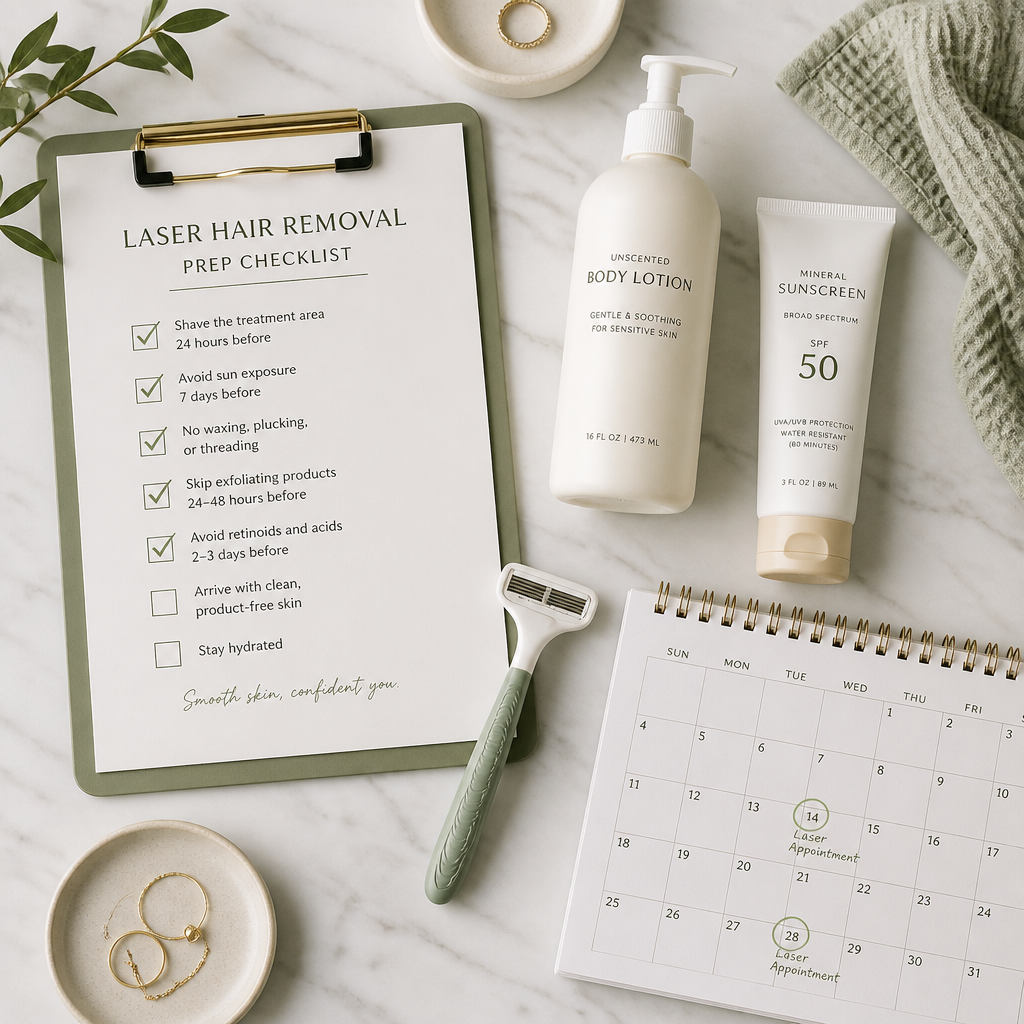

As you get closer to your appointment, the focus shifts to what you are putting on your skin. Two to three days before treatment, the treatment area needs a break from anything that could increase its sensitivity or cause a reaction when the laser is applied.
Stop using products containing retinoids, tretinoin, benzoyl peroxide, hydroquinone, salicylic acid, and glycolic acid on or near the treatment area. These ingredients are effective in your regular routine, but they make the skin more reactive, and applying laser energy to sensitised skin increases the risk of irritation and adverse effects.
Stick to gentle cleansing and a plain, fragrance-free moisturiser in the days before your appointment. You do not need to strip your routine entirely, just the actives on the specific zone being treated.
Any aesthetic treatment that causes physical or chemical exfoliation to the treatment area should be avoided for at least two weeks before a laser session. This includes chemical peels, microdermabrasion, and any treatment that leaves skin in a compromised or sensitised state. If you are unsure whether a treatment you have booked conflicts with your laser appointment, contact the clinic before proceeding.
When your skin is calm, not recently tanned, and free of waxed or plucked hairs, the laser can focus more accurately on the follicles, and you get more from every session.
The day before your appointment is when most of the practical preparation happens. Done correctly the evening before, this step makes the session go faster and keeps the skin in the best possible condition for treatment.
Shave the area you are having treated using a clean, fresh razor. The goal is to remove all surface hair so the laser energy is directed to the follicle beneath the skin rather than being absorbed by hair above the surface. Shaving the night before, rather than the morning of, is preferred because it allows any minor irritation from shaving to settle before you arrive at the clinic.
Use a moisturising shaving cream to reduce friction, and shave in the direction of hair growth to minimise irritation. Do not shave aggressively or repeatedly over the same patch of skin. For facial treatments, a close trim with scissors or a trimmer is acceptable if shaving is not practical for the area.
Avoid applying perfume, scented lotion, or deodorant to the treatment area the day before and on the morning of your appointment. These products leave residue on the skin that can interfere with the laser and cause unexpected reactions during treatment.
Pro tip: If you are having underarm treatment at Faith Laser, skip the deodorant completely the morning of your appointment. Pack an unscented one in your bag to apply after your session once the skin has settled.

The morning of your session, the checklist is shorter but just as important. Shower as normal, using gentle, unscented products, and ensure the treatment area is clean and completely free of any cosmetics, oils, lotions, or topical products. Do not apply anything to the skin being treated after your shower.
Wear loose, comfortable clothing that can be easily moved or removed to access the treatment area. Tight clothing immediately after a laser session can cause friction on skin that is temporarily sensitive and slightly warm. For leg or underarm treatments, loose-fit clothing is a practical choice. For intimate or bikini-line treatments, loose cotton underwear worn to and from the clinic makes a significant difference to your comfort post-treatment.
Your practitioner will review your medical history before treatment, particularly any medications you are taking. Certain medications, including some antibiotics and Accutane (isotretinoin), cause photosensitivity and may require your appointment to be postponed. Be open about everything you are taking, including supplements and topical prescriptions, so the practitioner can make the right call on your behalf. At Faith Laser, the consultation process is designed to make this straightforward, and the team will guide you through what applies to your situation specifically.
Laser hair removal works on the principle of selective photothermolysis: the laser light is absorbed by the melanin in the hair follicle, converting to heat that destroys the follicle. This means the contrast between the melanin in the hair and the melanin in the surrounding skin matters enormously. Clinics use the Fitzpatrick skin phototype scale to assess skin tone and calibrate treatment settings accordingly.
Lighter skin tones with darker hair provide the clearest contrast and generally see the fastest results. Darker skin tones require specific laser types, typically those using longer wavelengths such as Nd:YAG, with energy levels adjusted carefully to target the follicle without affecting the skin’s own pigment. Faith Laser uses the AW3 Crystal Freeze system, which is designed to treat a wide range of skin types while minimising discomfort through its built-in cooling technology.
Very light or white hair contains little melanin and responds poorly to most laser systems regardless of preparation. If you have blonde, grey, or red hair in the treatment area, discuss realistic expectations with your practitioner before committing to a course of sessions. Being honest about this upfront saves time and money.
Not all hair removal methods are equal in the weeks leading up to a laser session. Understanding why each approach either works or does not in the context of laser preparation helps you make the right choice without second-guessing it.
| Hair Removal Method | Safe to Use Before Laser? | Reason |
|---|---|---|
| Shaving | Yes. Shave 24 hours before. | Removes surface hair only. The follicle remains intact in the skin, giving the laser its correct target. |
| Waxing | No. Stop at least 4 to 6 weeks before. | Removes the follicle from the skin. Without a follicle present, the laser has nothing to destroy in those hairs. |
| Plucking or Tweezing | No. Stop at least 4 to 6 weeks before. | Same as waxing: the follicle is physically pulled out, leaving the laser without a target. Even plucking a few stray hairs can affect results in that area. |
| Depilatory Creams | Avoid in the week before treatment. | Chemical depilatories dissolve the hair shaft but leave the follicle intact, which is technically acceptable. However, the chemicals can irritate and sensitise the skin, making laser treatment uncomfortable. Check with your clinic first. |
| Epilators | No. Treat the same as waxing. | Epilators remove hair from the root mechanically. The follicle is removed from the skin, identical in effect to waxing. |
What you do in the first 24 to 48 hours after your session is part of the preparation mindset for your next appointment. Treated skin is temporarily sensitised, and certain activities will cause unnecessary irritation or slow recovery.
Skip hot baths, saunas, steam rooms, and intense exercise that causes sweating for at least 24 to 48 hours after treatment. Heat increases inflammation in already-sensitised skin. A lukewarm shower is fine; a hot tub is not. This is one of the most commonly ignored pieces of aftercare advice, and clients who ignore it are also the ones who report the most post-treatment redness.
Treated skin is significantly more photosensitive than usual in the days following a session. Apply a broad-spectrum SPF 30 or higher to any treated areas that will be exposed to daylight, and avoid direct sun on those areas where possible. This is especially relevant between sessions, because sun damage between appointments reduces the effectiveness of subsequent treatments and increases the risk of pigmentation issues.
After your first session, you may notice redness and mild swelling in the treated area, similar in appearance and feel to a light sunburn. This is a normal response and usually resolves within a few hours to a day. Avoid scratching or exfoliating the area, and do not apply active skincare products until the redness has fully subsided. If you experience anything beyond mild redness and warmth, contact the clinic directly. Faith Laser’s team is available to advise on any post-treatment concerns.
It is better to shave the evening before rather than the morning of your appointment. Shaving immediately before a session can leave micro-irritation on the skin surface, and the area needs a small amount of time to settle. Shaving 12 to 24 hours before is the standard recommendation, but if you forget and need to shave on the morning, use a fresh razor and moisturising shaving cream, and let the clinic know when you arrive.
Most clients describe the sensation as a quick, warm snap, similar to a rubber band flicking against the skin. The level of discomfort varies by treatment area, with areas over bony structures or thin skin feeling more intense than others. Faith Laser uses the AW3 Crystal Freeze system, which incorporates a cooling mechanism designed to minimise discomfort throughout the session. Being well-prepared with properly shaved, lotion-free skin also reduces unnecessary irritation during treatment.
The number of sessions needed varies based on factors including hair thickness, hair colour, skin tone, the treatment area, and individual hair growth cycles. Most people require somewhere in the range of six to eight sessions to achieve significant long-term reduction. Each session targets hairs in their active growth phase, which is why multiple appointments spaced across the hair growth cycle are necessary. Your practitioner at Faith Laser will give you a more specific estimate based on your consultation.
There is no firm clinical requirement to avoid caffeine, but some practitioners suggest limiting it before treatment because caffeine can heighten sensitivity to discomfort. If you are already anxious about your first appointment, a large coffee beforehand may not serve you well. Staying well-hydrated with water before your session is always a sensible approach regardless.
If your practitioner assesses that your skin has a visible tan, active sunburn, or recently applied self-tanner on the treatment area, your appointment will likely need to be rescheduled. This is not an overreaction: treating tanned skin increases the risk of burns and pigmentation damage. The safest course is always to reschedule and return once the tan has fully faded, rather than proceed with treatment on compromised skin.
Topical numbing creams are sometimes used before laser treatment, particularly for sensitive areas. If you are considering this, discuss it with the clinic before your appointment rather than applying anything on your own. Some numbing products can affect how the skin responds to the laser, and the clinic may have specific products they recommend or prefer you to avoid. Do not apply any numbing cream without first confirming it is acceptable to your practitioner.
Have you already had your first laser hair removal session?