Most people walk into their first laser hair removal consultation expecting a simple answer. They want a number. What they get instead is a range, a list of caveats, and a treatment plan that can feel vague. The honest truth is that laser hair removal sessions are not one-size-fits-all, but that does not mean the answer has to be confusing. This guide cuts through the uncertainty and gives you a realistic picture of what to expect, based on the factors that actually matter. Whether you are considering treatment at Faith Laser in Liverpool or just researching your options, you deserve a straight answer.
Key Insight | Explanation |
|---|---|
Most people need 8 to 10 sessions | This is the typical range for professional laser treatment covering a single body area, though some clients need more depending on hair and skin characteristics. |
Hair growth cycles are the limiting factor | Laser only affects hair in the active growth phase. Because not all hairs are active at the same time, multiple spaced sessions are non-negotiable. |
Darker, coarser hair responds fastest | The laser targets pigment (melanin). Dark, thick hair absorbs more laser energy, which means quicker and more visible results per session. |
Hormonal conditions can double your session count | Conditions such as polycystic ovary syndrome (PCOS) can cause ongoing hormonal hair stimulation, meaning maintenance sessions are often needed long-term. |
Spacing between sessions is not optional | Sessions are typically spaced 4 to 8 weeks apart depending on the body area. Not sticking to a schedule reduces effectiveness significantly. |
Professional clinic sessions outperform at-home devices | Clinical-grade equipment operates at energy levels that at-home IPL tools cannot match, meaning fewer sessions to achieve better results. |
A free consultation changes your estimate dramatically | Skin tone, hair colour, treatment area, and medical history all shift the session count. A proper consultation at a clinic gives you a personalised plan rather than a guess. |
The honest answer for most people is between 8 and 10 sessions for a single treatment area, with sessions spaced several weeks apart. Some areas of the body and some hair types can be resolved closer to the 6-session mark. Others, particularly areas with hormonally influenced hair growth such as the chin, upper lip, or bikini line, often require 8 or more sessions to reach a result that feels truly complete.
This is not a marketing estimate designed to sell you a larger package. It reflects the biology of how hair grows. Hair follicles cycle through active growth (anagen), regression (catagen), and resting (telogen) phases. A laser pulse only destroys a follicle when the hair is in the anagen phase. At any given moment, only a portion of the hairs in a treatment area are in that phase, which is exactly why a single session cannot clear everything at once.
At Faith Laser in Liverpool, clients receive an honest assessment during their initial consultation so that the session plan reflects their specific situation rather than a generic industry average. That matters far more than a number pulled from a general guide.
Pro tip: Do not judge the effectiveness of your treatment after just two or three sessions. Visible shedding and hair reduction typically become dramatic between sessions 3 and 5, not before.
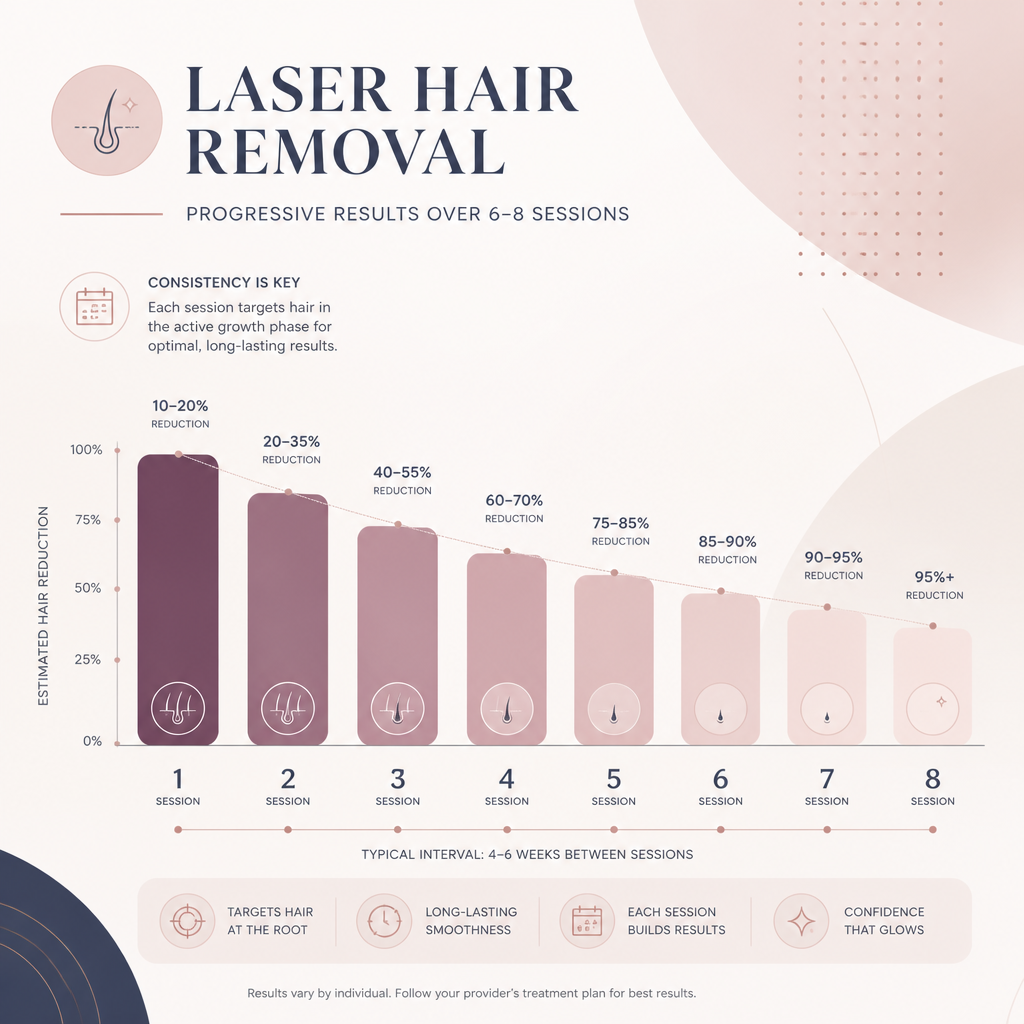
Several variables interact to determine your personal session count. Understanding them means you can go into a consultation with realistic expectations rather than being surprised later.
The laser targets melanin, the pigment that gives hair its colour. Dark brown and black hair responds most strongly because it absorbs the laser energy efficiently. Fair, blonde, grey, or red hair contains less melanin and responds more slowly, often requiring additional sessions or, in some cases, not being a suitable candidate for laser at all. Coarse hair also tends to respond faster than fine hair because thicker shafts carry more pigment to the follicle.
Modern clinical lasers, including the technology used at professional clinics like Faith Laser, are calibrated to work safely across a range of skin tones. However, the contrast between hair colour and skin tone still influences how aggressively settings can be applied. A practitioner adjusts wavelength and energy levels accordingly, which can affect the number of sessions needed to reach the same outcome.
The face, particularly the upper lip, chin, and jaw, is one of the most commonly treated areas and also one of the most session-intensive. This is because facial hair in these zones is often driven by hormones. Even after successful laser treatment, hormonal changes (puberty, pregnancy, menopause, or a condition such as PCOS) can stimulate dormant follicles. This does not mean treatment fails. It means that periodic maintenance sessions are a realistic part of the long-term plan for these areas.
Clients who have waxed or threaded recently may need to wait before starting treatment, as these methods temporarily remove the hair shaft that the laser needs to travel down to reach the follicle. Shaving, by contrast, leaves the shaft intact below the skin surface and is the recommended preparation method before a session.
Breaking the session count down by area is more useful than a single blanket figure. The ranges below reflect what a professional clinic typically sees across a broad client base, not a guarantee for any individual.
Body Area | Typical Session Range | Key Influencing Factor |
|---|---|---|
Underarms | 6 to 8 sessions | Generally responds well; hair is often coarse and dark |
Bikini line / intimate zones | 6 to 9 sessions | Hormonal influence can extend the count |
Upper lip | 8 to 12 sessions | Strong hormonal drive; fine hairs may need more passes |
Chin and jaw | 8 to 12 sessions | As above; maintenance often needed |
Lower legs | 6 to 8 sessions | Large surface area but lower hormonal influence |
Full legs | 6 to 8 sessions | Consistent hair cycle across the area |
Back and shoulders | 7 to 10 sessions | Hair cycles can be slower in this area |
Faith Laser treats all of the areas listed above, including underarms, intimate zones, and facial treatments. If you are treating multiple areas simultaneously, the clinic can often bundle sessions into packages that are more cost-effective than booking each area individually.
Pro tip: If you are treating both a body area and a facial area at the same time, expect the facial area to take longer. Do not use the body area as your benchmark for when to stop.
At-home IPL devices have become a popular alternative, and they sometimes produce results for the right candidate. Consumer testing of devices such as the Philips Lumea IPL 9000 and similar tools shows that they can reduce hair growth over time. However, comparing session counts between at-home devices and professional clinical treatment is not a like-for-like comparison.
Clinical lasers operate at significantly higher energy levels and use precise wavelengths calibrated for the individual’s skin tone and hair type. At-home IPL devices are designed with safety margins that necessarily reduce output power, because the consumer is applying the device without professional oversight. The result is that achieving a comparable level of hair reduction typically takes considerably more sessions with an at-home device than with professional treatment.
A common oversight when budgeting for laser hair removal is counting only the upfront session cost without accounting for how many sessions each method actually requires to reach the same outcome. The cheaper per-session cost of an at-home device can be misleading if it takes significantly more uses to match a clinic result.
There is also the question of who the devices work for. At-home IPL devices are generally most effective on lighter skin tones with darker hair. Professional clinics such as Faith Laser work with a broader range of skin tones and hair types because the equipment and expertise allow for safer, more targeted settings. If you have a darker skin tone, a professional clinic is not just a preference, it is the safer and more effective choice.
The gap between sessions is where most of the work actually happens. After a laser session, treated hairs enter a shedding phase. Over the following 1 to 3 weeks, you will notice hairs appearing to push out of the skin. This is a normal sign that the follicle has been damaged. Do not wax or tweeze these hairs out. Let them shed naturally.
The spacing between sessions, typically 4 to 6 weeks for facial areas and 6 to 8 weeks for body areas, is calibrated to the hair growth cycle. Going back too soon means treating hairs that are not yet in the active phase, which wastes a session. Waiting too long does not cause harm, but it can slow your overall progress. Sticking to the schedule your practitioner recommends is one of the simplest ways to keep your session count as low as possible.
Sun exposure is the most important thing to manage between sessions. Tanned skin changes the contrast between hair and skin, which can reduce effectiveness and increase the risk of skin reactions. This is particularly relevant for clients in Liverpool during the summer months when outdoor activity increases. Broad-spectrum SPF 50 on treated areas is standard advice between appointments.
Avoid using fake tan products, retinoid creams, or exfoliating acids on the treated area in the days leading up to your next session. Your practitioner at Faith Laser will give you a specific pre-session checklist, and following it is directly linked to how well each session performs.
Clients often worry when they cannot immediately see a dramatic change after early sessions. Here is what actually indicates that the treatment is working as expected.
After session 1 and 2, you may notice that regrowth is slightly slower than usual. That is a good sign, but it is subtle. After session 3 or 4, many clients report that the hair that does grow back is finer, lighter, and sparser than before treatment began. By session 5 or 6, the majority of clients in suitable hair and skin categories will see clear, significant reduction in the treated area.
Patchiness is normal in the early stages. Because the laser only catches hairs in the active phase, you will often see uneven regrowth during treatment. This is not a sign of failure. It reflects the natural variation in hair cycles across a treatment area and evens out as sessions accumulate.
If you reach session 6 or 7 and see very little change at all, that is the time to revisit the conversation with your practitioner. In some cases, the laser settings need adjustment. In others, an underlying hormonal factor has not yet been addressed. A good clinic addresses this honestly rather than just booking more sessions without explanation.
If you are based in Liverpool and want a realistic, personalised session estimate rather than a generic range, book a consultation with Faith Laser to discuss your specific hair type, skin tone, and treatment goals.
It is very unlikely. Three sessions is not enough to catch the majority of hairs through their active growth cycle, even under ideal conditions. Some clients with very dark, coarse hair on low-hormonal-influence areas might see strong reduction by session 4 or 5, but 3 sessions is not a realistic endpoint for most people. Any clinic telling you otherwise is underselling the process.
The upper lip is one of the more session-intensive areas because of its strong hormonal influence and the fine nature of the hair. Most clients need between 8 and 12 sessions, and some require periodic maintenance after that. The sessions are short in duration because of the small surface area, but cutting the count short tends to lead to disappointing results.
Professional clinics with modern equipment can treat a broad range of skin tones safely. The technology and settings vary depending on skin tone, and darker skin tones in particular benefit from being treated by an experienced practitioner using the correct laser type. At-home IPL devices are generally not recommended for darker skin tones due to the risk of adverse skin reactions at the energy levels those devices use.
PCOS causes ongoing hormonal stimulation of hair follicles, which means that even after successful laser treatment, new follicles can be activated over time. Most clients with PCOS complete the standard 6 to 8 session course and then return for maintenance sessions every 6 to 12 months. The treatment still works and is still worth doing. It just requires a longer-term management mindset rather than expecting a one-time fix.
Yes, in practice. Male hair tends to be coarser and more densely packed, which can actually improve laser response in some areas. However, male facial hair, particularly on the beard line and neck, is among the most hormonally driven hair on the body and can require more sessions and ongoing maintenance than most other areas on either sex. Body areas such as the back and shoulders in men also tend to need a slightly higher session count due to slower hair cycling in those zones.
Almost certainly, yes, for at least some areas. Most clinics, including Faith Laser, are upfront about this. The majority of clients achieve 80 to 90 percent reduction after a full course and may then need one or two maintenance sessions per year to address regrowth from follicles that were dormant during the initial course. This is normal, not a sign the treatment has failed.
We would love your feedback and any insights you would share with others. What perspective would you add?